Ch.16 - Acid-Base Equilibria
Brown - Chemistry: The Central Science 14th Edition
Brown14th EditionChemistry: The Central ScienceISBN: 9780134414232Non è quello che usi tu?Cambia libro di testo
Capitolo 16, Problema 47

Calculate the concentration of an aqueous solution of NaOH that has a pH of 11.50.

Guida verificata passo dopo passo
1
Step 1: Understand that pH is a measure of the hydrogen ion concentration in a solution. The pH is related to the pOH by the equation: \( \text{pH} + \text{pOH} = 14 \).
Step 2: Calculate the pOH of the solution using the given pH value: \( \text{pOH} = 14 - \text{pH} \). Substitute the given pH of 11.50 into the equation.
Step 3: Convert the pOH to hydroxide ion concentration \([\text{OH}^-]\) using the formula: \([\text{OH}^-] = 10^{-\text{pOH}}\).
Step 4: Recognize that the concentration of NaOH in the solution is equal to the concentration of \([\text{OH}^-]\) because NaOH dissociates completely in water.
Step 5: Use the calculated \([\text{OH}^-]\) concentration as the concentration of the NaOH solution.

Concetti chiave

Ecco i concetti essenziali che devi comprendere per rispondere correttamente alla domanda.

pH Scale

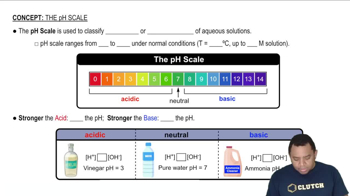
The pH scale measures the acidity or basicity of a solution, ranging from 0 to 14. A pH of 7 is neutral, while values below 7 indicate acidity and above 7 indicate basicity. Each unit change in pH represents a tenfold change in hydrogen ion concentration, making it crucial for understanding the behavior of acids and bases in solution.
Video consigliato:

Concentration of Hydroxide Ions

In basic solutions, the concentration of hydroxide ions (OH-) is significant. The relationship between pH and hydroxide ion concentration can be derived from the equation pOH = 14 - pH. For a pH of 11.50, the pOH can be calculated, allowing for the determination of the hydroxide ion concentration, which is essential for calculating the concentration of NaOH in the solution.
Video consigliato:
Percorso guidato
06:12
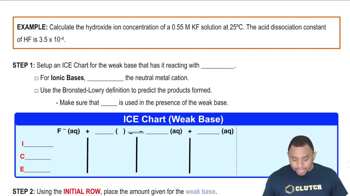
Hydroxide Ion Concentration Example

Stoichiometry of NaOH Dissociation

Sodium hydroxide (NaOH) is a strong base that completely dissociates in water into sodium ions (Na+) and hydroxide ions (OH-). The stoichiometry of this dissociation means that the concentration of NaOH is equal to the concentration of OH- produced. Understanding this relationship is vital for calculating the concentration of the NaOH solution based on the hydroxide ion concentration derived from the pH.
Video consigliato:
Percorso guidato
01:16
Stoichiometry Concept