
Ch.16 - Acid-Base Equilibria
Brown - Chemistry: The Central Science 14th Edition
Brown14th EditionChemistry: The Central ScienceISBN: 9780134414232Non è quello che usi tu?Cambia libro di testo
Capitolo 16, Problema 116

Calculate the number of H3O+ ions in 1.0 mL of pure water at 25 °C.

Guida verificata passo dopo passo
1
Step 1: Understand that pure water at 25 °C is neutral, meaning the concentration of H3O+ ions is equal to the concentration of OH- ions.
Step 2: Recall that the concentration of H3O+ ions in pure water at 25 °C is 1.0 × 10⁻⁷ M.
Step 3: Convert the volume of water from milliliters to liters, since molarity is expressed in moles per liter. For 1.0 mL, this is 0.001 L.
Step 4: Use the formula for moles: moles = concentration (M) × volume (L). Substitute the known values to find the moles of H3O+ ions.
Step 5: Convert the moles of H3O+ ions to the number of ions using Avogadro's number (6.022 × 10²³ ions/mol).

Concetti chiave

Ecco i concetti essenziali che devi comprendere per rispondere correttamente alla domanda.

Ionization of Water

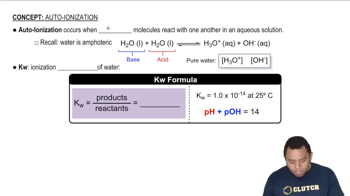
Water undergoes self-ionization, where two water molecules produce one hydroxide ion (OH<sup>-</sup>) and one hydronium ion (H<sub>3</sub>O<sup>+</sup>). This process is essential for understanding the concentration of H<sub>3</sub>O<sup>+</sup> ions in pure water, which occurs at a very low level.
Video consigliato:
Percorso guidato
02:22
Auto-Ionization and Kw

pH and Concentration of Ions

The pH scale measures the acidity or basicity of a solution, defined as the negative logarithm of the H<sub>3</sub>O<sup>+</sup> concentration. In pure water at 25 °C, the pH is 7, indicating that the concentration of H<sub>3</sub>O<sup>+</sup> ions is 1.0 x 10<sup>-7</sup> M, which is crucial for calculating the number of ions in a given volume.
Video consigliato:
Percorso guidato
06:25
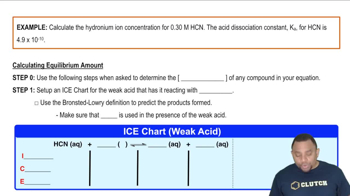
Hydronium Ion Concentration Example

Avogadro's Number

Avogadro's number (6.022 x 10<sup>23</sup> entities/mol) is used to convert between moles of a substance and the number of individual particles, such as ions. To find the total number of H<sub>3</sub>O<sup>+</sup> ions in 1.0 mL of water, one must first calculate the number of moles in that volume and then use Avogadro's number to determine the total count of ions.
Video consigliato:
Pratica correlata
Domanda del libro di testo

The amino acid glycine (H2N–CH2–COOH) can participate in the following equilibria in water:

H2N–CH2–COOH + H2O ⇌ H2N–CH2–COO– + H3O+ Ka = 4.3 × 10⁻³

H2N–CH2–COOH + H2O⇌ +H3N–CH2–COOH + OH- Kb = 6.0 × 10⁻⁵

(b) What is the pH of a 0.050 M aqueous solution of glycine?

466
views
Domanda del libro di testo
The volume of an adult's stomach ranges from about 50 mL when empty to 1 L when full. If the stomach volume is 400 mL and its contents have a pH of 2, how many moles of H+ does the stomach contain? Assuming that all the H+ comes from HCl, how many grams of sodium hydrogen carbonate will totally neutralize the stomach acid?
1108
views
Domanda del libro di testo

Atmospheric CO2 levels have risen by nearly 20% over the past 40 years from 320 ppm to 400 ppm. (a) Given that the average pH of clean, unpolluted rain today is 5.4, determine the pH of unpolluted rain 40 years ago. Assume that carbonic acid 1H2CO32 formed by the reaction of CO2 and water is the only factor influencing pH. CO21g2 + H2O1l2 Δ H2CO31aq2

427
views
Domanda del libro di testo

The amino acid glycine (H2N–CH2–COOH) can participate in the following equilibria in water:

H2N–CH2–COOH + H2O ⇌ H2N–CH2–COO– + H3O+ Ka = 4.3 × 10⁻³

H2N–CH2–COOH + H2O⇌ +H3N–CH2–COOH + OH- Kb = 6.0 × 10⁻⁵

(a) Use the values of Ka and Kb to estimate the equilibrium constant for the intramolecular proton transfer to form a zwitterion: H2N–CH2–COOH ⇌ +H3N–CH2–COO–

886
views