
Ch.16 - Acid-Base Equilibria
Brown - Chemistry: The Central Science 14th Edition
Brown14th EditionChemistry: The Central ScienceISBN: 9780134414232Non è quello che usi tu?Cambia libro di testo
Capitolo 16, Problema 115

The pKb of water is _______. (a) 1 (b) 7 (c) 14 (d) not defined (e) none of the above

Guida verificata passo dopo passo
1
Step 1: Understand the concept of pKb. The pKb is the negative logarithm of the base dissociation constant (Kb) of a substance. It is used to express the strength of a base in solution.
Step 2: Recall the autoionization of water. Water can act as both an acid and a base, and it undergoes autoionization to form hydronium (H3O+) and hydroxide (OH-) ions.
Step 3: Consider the equilibrium constant for water's autoionization. The equilibrium constant for this reaction is known as the ion product of water (Kw), which is equal to 1.0 x 10^-14 at 25°C.
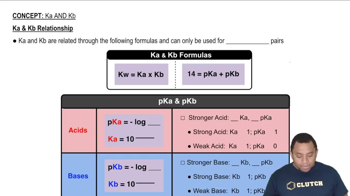
Step 4: Relate pKw to pKa and pKb. For water, pKw = pKa + pKb. Since pKw is 14 at 25°C and water is neutral, pKa and pKb are equal, each being 7.
Step 5: Conclude that the pKb of water is 7, based on the relationship between pKw, pKa, and pKb.

Concetti chiave

Ecco i concetti essenziali che devi comprendere per rispondere correttamente alla domanda.

pKb and pKa

pKb is a measure of the basicity of a substance, specifically the negative logarithm of the base dissociation constant (Kb). It indicates how readily a base accepts protons in solution. The relationship between pKa and pKb is crucial, as they are related through the equation pKa + pKb = 14 at 25°C, which is essential for understanding acid-base equilibria.
Video consigliato:
Percorso guidato
03:01
Ka and Kb Relationship

Water as an Amphoteric Substance

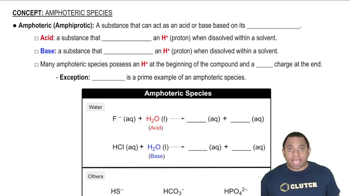
Water (H2O) is considered an amphoteric substance because it can act both as an acid and a base. This dual behavior allows water to participate in various acid-base reactions, contributing to its role in chemical equilibria. Understanding this property is vital for grasping the context of pKb values in relation to water.
Video consigliato:
Percorso guidato
03:03
Amphoteric Species

Dissociation of Water

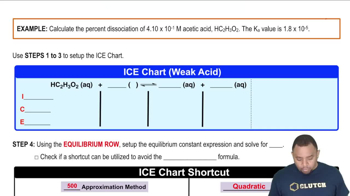
The dissociation of water into hydrogen ions (H+) and hydroxide ions (OH-) is a fundamental concept in chemistry, represented by the equilibrium expression Kw = [H+][OH-]. At 25°C, Kw is 1.0 x 10^-14, leading to the conclusion that the pH and pOH of pure water are both 7. This equilibrium is essential for understanding the pKb of water and its implications in acid-base chemistry.
Video consigliato:
Percorso guidato
04:52
Percent Dissociation Example