Ch.16 - Acid-Base Equilibria
Brown - Chemistry: The Central Science 14th Edition
Brown14th EditionChemistry: The Central ScienceISBN: 9780134414232Non è quello che usi tu?Cambia libro di testo
Capitolo 16, Problema 59a,b

Calculate the pH of each of the following solutions (Ka and Kb values are given in Appendix D): (a) 0.095 M propionic acid (C2H5COOH) (b) 0.100 M hydrogen chromate ion (HCrO4-)

Guida verificata passo dopo passo
1
Identify the chemical species involved: The hydrogen chromate ion, \( \text{HCrO}_4^- \), is an acidic species.
Determine the relevant equilibrium: The hydrogen chromate ion can donate a proton (\( \text{H}^+ \)) to form \( \text{CrO}_4^{2-} \). The equilibrium expression is \( \text{HCrO}_4^- \rightleftharpoons \text{H}^+ + \text{CrO}_4^{2-} \).
Write the expression for the acid dissociation constant \( K_a \): \( K_a = \frac{[\text{H}^+][\text{CrO}_4^{2-}]}{[\text{HCrO}_4^-]} \).
Set up an ICE table (Initial, Change, Equilibrium) to determine the concentrations of each species at equilibrium. Assume initial concentration of \( \text{HCrO}_4^- \) is 0.100 M, and initial concentrations of \( \text{H}^+ \) and \( \text{CrO}_4^{2-} \) are 0.
Solve for \([\text{H}^+]\) using the \( K_a \) expression and the equilibrium concentrations from the ICE table, then calculate the pH using \( \text{pH} = -\log[\text{H}^+] \).

Risposta video verificata per un problema simile:

Questa soluzione video è stata consigliata dai nostri tutor come utile per risolvere questo problema.
Durata del video:
6m

Concetti chiave

Ecco i concetti essenziali che devi comprendere per rispondere correttamente alla domanda.

Acid-Base Equilibrium

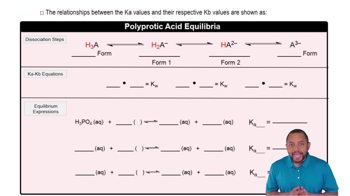
Acid-base equilibrium refers to the balance between the concentrations of acids and bases in a solution. In this context, the hydrogen chromate ion (HCrO4-) can act as a weak acid, donating protons to the solution. Understanding how to set up the equilibrium expression using the acid dissociation constant (Ka) is essential for calculating the pH.
Video consigliato:
Percorso guidato
6:47
Triprotic Acid Equilibrium

pH Calculation

pH is a measure of the acidity or basicity of a solution, defined as the negative logarithm of the hydrogen ion concentration. To calculate the pH of a solution containing a weak acid, one must first determine the concentration of hydrogen ions produced at equilibrium, often using the formula pH = -log[H+]. This requires knowledge of the initial concentration and the dissociation constant.
Video consigliato:
Percorso guidato
02:15
pH Calculation Example

Dissociation Constants (Ka and Kb)

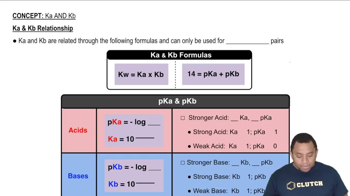
Dissociation constants, Ka for acids and Kb for bases, quantify the strength of an acid or base in solution. For the hydrogen chromate ion, the relevant Ka value indicates how readily it donates protons. Knowing these constants allows for the calculation of equilibrium concentrations, which are crucial for determining the pH of the solution.
Video consigliato:
Percorso guidato
03:01
Ka and Kb Relationship