Ch.16 - Acid-Base Equilibria
Brown - Chemistry: The Central Science 14th Edition
Brown14th EditionChemistry: The Central ScienceISBN: 9780134414232Non è quello che usi tu?Cambia libro di testo
Capitolo 16, Problema 58

The acid-dissociation constant for chlorous acid 1HClO22 is 1.1 * 10-2. Calculate the concentrations of H3O+, ClO2-, and HClO2 at equilibrium if the initial concentration of HClO2 is 0.0125 M.

Guida verificata passo dopo passo
1
Write the balanced chemical equation for the dissociation of chlorous acid: \( \text{HClO}_2 \rightleftharpoons \text{H}^+ + \text{ClO}_2^- \).
Set up the expression for the acid-dissociation constant \( K_a \): \( K_a = \frac{[\text{H}^+][\text{ClO}_2^-]}{[\text{HClO}_2]} \).
Substitute the given \( K_a \) value and initial concentration into the expression: \( 1.1 \times 10^{-2} = \frac{x^2}{0.0125 - x} \), where \( x \) is the change in concentration.
Assume \( x \) is small compared to the initial concentration, simplifying the expression to \( 1.1 \times 10^{-2} = \frac{x^2}{0.0125} \).
Solve for \( x \) to find the equilibrium concentrations of \( [\text{H}^+] = x \), \( [\text{ClO}_2^-] = x \), and \( [\text{HClO}_2] = 0.0125 - x \).

Risposta video verificata per un problema simile:

Questa soluzione video è stata consigliata dai nostri tutor come utile per risolvere questo problema.
Durata del video:
4m

Concetti chiave

Ecco i concetti essenziali che devi comprendere per rispondere correttamente alla domanda.

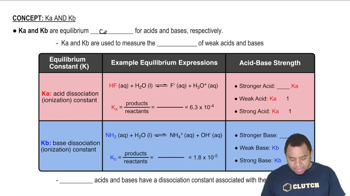
Acid-Dissociation Constant (Ka)

The acid-dissociation constant (Ka) quantifies the strength of an acid in solution. It is defined as the equilibrium constant for the dissociation of an acid into its conjugate base and hydronium ions. A higher Ka value indicates a stronger acid, which dissociates more completely in solution. For chlorous acid (HClO2), a Ka of 1.1 x 10^-2 suggests it is a weak acid, partially dissociating in water.
Video consigliato:
Percorso guidato
03:50
Characteristics of Ka and Kb

Equilibrium Concentrations

At equilibrium, the concentrations of reactants and products remain constant over time. In the context of acid dissociation, this involves calculating the concentrations of H3O+, ClO2-, and HClO2 after the dissociation reaction has reached equilibrium. The initial concentration of the acid and the change in concentration due to dissociation are used to determine these equilibrium concentrations.
Video consigliato:
Percorso guidato
02:35
Thermal Equilibrium

ICE Table

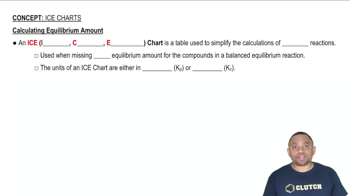
An ICE table (Initial, Change, Equilibrium) is a tool used to organize the concentrations of reactants and products in a chemical reaction. It helps in visualizing the initial concentrations, the changes that occur as the reaction proceeds, and the final equilibrium concentrations. For the dissociation of HClO2, the ICE table will facilitate the calculation of the concentrations of H3O+, ClO2-, and HClO2 at equilibrium based on the initial concentration and the dissociation constant.
Video consigliato:
Percorso guidato
01:14
ICE Charts and Equilibrium Amount