
Ch.16 - Acid-Base Equilibria
Brown - Chemistry: The Central Science 14th Edition
Brown14th EditionChemistry: The Central ScienceISBN: 9780134414232Non è quello che usi tu?Cambia libro di testo
Capitolo 16, Problema 67a

Consider the base hydroxylamine, NH2OH. (a) What is the conjugate acid of hydroxylamine?

Guida verificata passo dopo passo
1
Identify the base in the problem: hydroxylamine, which is NH2OH.
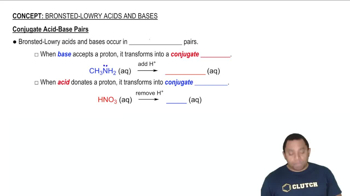
Recall the concept of a conjugate acid: it is formed when a base gains a proton (H+).
Add a proton (H+) to the base NH2OH. This involves adding an H+ ion to the nitrogen atom, which is the site of protonation.
Write the chemical formula of the conjugate acid: NH3OH+.
Verify the charge balance: The original base NH2OH is neutral, and after gaining a proton, the conjugate acid NH3OH+ has a positive charge.

Risposta video verificata per un problema simile:

Questa soluzione video è stata consigliata dai nostri tutor come utile per risolvere questo problema.
Durata del video:
1m

Concetti chiave

Ecco i concetti essenziali che devi comprendere per rispondere correttamente alla domanda.

Conjugate Acid-Base Pairs

In acid-base chemistry, a conjugate acid is formed when a base accepts a proton (H+). This concept is essential for understanding how substances interact in chemical reactions, particularly in Brønsted-Lowry acid-base theory, which defines acids as proton donors and bases as proton acceptors.
Video consigliato:
Percorso guidato
01:30
Conjugate Acid-Base Pairs

Protonation

Protonation is the process by which a molecule gains a proton, resulting in the formation of a conjugate acid. For hydroxylamine (NH2OH), protonation occurs at the nitrogen atom, which has a lone pair of electrons that can bond with a proton, leading to the formation of its conjugate acid.
Video consigliato:
Percorso guidato
01:38
Neutron-to-Proton Plot

Hydroxylamine Structure

Hydroxylamine (NH2OH) consists of an amine group (NH2) and a hydroxyl group (OH). Understanding its molecular structure is crucial for predicting its behavior in acid-base reactions, including how it can act as a base and what its conjugate acid will be when it accepts a proton.
Video consigliato:
Percorso guidato
01:42
Resonance Structures