Ch.16 - Acid-Base Equilibria
Brown - Chemistry: The Central Science 14th Edition
Brown14th EditionChemistry: The Central ScienceISBN: 9780134414232Non è quello che usi tu?Cambia libro di testo
Capitolo 16, Problema 68a

The hypochlorite ion, ClO-, acts as a weak base. (a) Is ClO- a stronger or weaker base than hydroxylamine?

Guida verificata passo dopo passo
1
Step 1: To determine whether ClO- is a stronger or weaker base than hydroxylamine, we need to compare their base ionization constants (Kb).
Step 2: The base ionization constant (Kb) is a measure of the strength of a base. The larger the Kb, the stronger the base.
Step 3: Look up the Kb values for ClO- and hydroxylamine in a table of ionization constants. These values can be found in a chemistry textbook or reliable online source.
Step 4: Compare the Kb values. If the Kb of ClO- is larger than that of hydroxylamine, then ClO- is a stronger base. If the Kb of ClO- is smaller, then it is a weaker base.
Step 5: Remember that the strength of a base is also related to the stability of its conjugate acid. A base that has a more stable conjugate acid will be weaker because it is less likely to accept a proton.

Risposta video verificata per un problema simile:

Questa soluzione video è stata consigliata dai nostri tutor come utile per risolvere questo problema.
Durata del video:
1m

Concetti chiave

Ecco i concetti essenziali che devi comprendere per rispondere correttamente alla domanda.

Acid-Base Theory

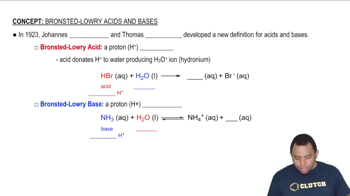
Acid-base theory explains the behavior of substances in terms of proton (H+) transfer. According to the Brønsted-Lowry theory, acids donate protons while bases accept them. Understanding this concept is crucial for comparing the basicity of different species, such as the hypochlorite ion (ClO-) and hydroxylamine.
Video consigliato:
Percorso guidato
02:08
Bronsted-Lowry Acid-Base Theory

Weak Bases

Weak bases are substances that do not completely dissociate in solution to produce hydroxide ions (OH-). Instead, they establish an equilibrium between the undissociated base and its ions. The strength of a weak base can be assessed by its base dissociation constant (Kb), which indicates its ability to accept protons compared to other weak bases.
Video consigliato:
Percorso guidato
00:51
ICE Charts of Weak Bases

Comparative Basicity

Comparative basicity involves evaluating the strength of different bases based on their ability to accept protons. This can be determined by examining their Kb values or their conjugate acids' stability. In this context, comparing ClO- with hydroxylamine requires analyzing their respective structures and the stability of their conjugate acids to conclude which is the stronger base.
Video consigliato:
Percorso guidato
01:04
Balancing Basic Redox Reactions