
Ch.16 - Acid-Base Equilibria
Brown - Chemistry: The Central Science 14th Edition
Brown14th EditionChemistry: The Central ScienceISBN: 9780134414232Non è quello che usi tu?Cambia libro di testo
Capitolo 16, Problema 5a

The following diagrams represent aqueous solutions of three acids, HX, HY, and HZ. The water molecules have been omitted for clarity, and the hydrated proton is represented as H+ rather than H3O+. (a) Which of the acids is a strong acid? Explain.
Diagrams of aqueous solutions for acids HX and HY, showing H+ ions and their respective anions.

Guida verificata passo dopo passo
1
Identify the components in each diagram: HX and HY.
Observe the dissociation of each acid in water. For HX, note the presence of H+ and X- ions. For HY, note the presence of H+ and Y- ions.
Determine the extent of dissociation for each acid. A strong acid will dissociate completely in water, producing a high concentration of H+ ions.
Compare the number of H+ ions in each solution. The solution with the higher concentration of H+ ions indicates the stronger acid.
Conclude which acid is the strong acid based on the extent of dissociation and the concentration of H+ ions observed in the diagrams.

Risposta video verificata per un problema simile:

Questa soluzione video è stata consigliata dai nostri tutor come utile per risolvere questo problema.
Durata del video:
50s

Concetti chiave

Ecco i concetti essenziali che devi comprendere per rispondere correttamente alla domanda.

Strong vs. Weak Acids

Strong acids completely dissociate in water, releasing all their protons (H+) into the solution, resulting in a high concentration of H+ ions. In contrast, weak acids only partially dissociate, leading to a lower concentration of H+ ions. Understanding this distinction is crucial for identifying the strength of an acid based on its behavior in aqueous solutions.
Video consigliato:
Percorso guidato
02:19
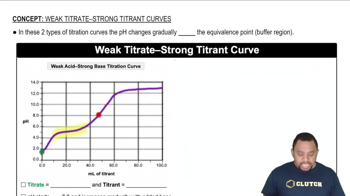
Weak Acid-Strong Base Titration Curve

Dissociation Equilibrium

The dissociation of acids in water can be described by an equilibrium constant (Ka) that quantifies the extent of dissociation. For strong acids, the Ka is very large, indicating that the reaction favors the formation of products (H+ and anions). In weak acids, the Ka is smaller, reflecting a significant amount of undissociated acid remaining in solution.
Video consigliato:
Percorso guidato
02:35
Thermal Equilibrium

Hydrated Protons (H+ vs. H3O+)

In aqueous solutions, protons (H+) do not exist freely; they are associated with water molecules, forming hydronium ions (H3O+). For simplicity, H+ is often used in equations, but recognizing that it represents H3O+ is important for understanding acid-base chemistry. This distinction is relevant when analyzing the concentration of protons in solutions of different acids.
Video consigliato:
Percorso guidato
02:04
Ionic Hydrates Naming