
Ch.16 - Acid-Base Equilibria
Brown - Chemistry: The Central Science 14th Edition
Brown14th EditionChemistry: The Central ScienceISBN: 9780134414232Non è quello che usi tu?Cambia libro di testo
Capitolo 16, Problema 5b

The following diagrams represent aqueous solutions of three acids, HX, HY, and HZ. The water molecules have been omitted for clarity, and the hydrated proton is represented as H+ rather than H3O+.(b) Which acid would have the smallest aciddissociation constant, Ka?
Diagrams of three acids, HA, HB, and HC, showing their molecular structures for acid dissociation analysis.

Guida verificata passo dopo passo
1
Identify the degree of dissociation for each acid by counting the number of dissociated ions (H+ and the corresponding anion) in each diagram.
Compare the number of dissociated ions for each acid. The acid with the fewest dissociated ions has the smallest degree of dissociation.
Recall that the acid dissociation constant, Ka, is a measure of the strength of an acid in solution. A smaller degree of dissociation indicates a weaker acid and thus a smaller Ka value.
Determine which acid (HA, HB, or HC) has the smallest degree of dissociation based on the diagrams.
Conclude that the acid with the smallest degree of dissociation has the smallest Ka value.

Risposta video verificata per un problema simile:

Questa soluzione video è stata consigliata dai nostri tutor come utile per risolvere questo problema.
Durata del video:
2m

Concetti chiave

Ecco i concetti essenziali che devi comprendere per rispondere correttamente alla domanda.

Acid Dissociation Constant (Ka)

The acid dissociation constant, Ka, quantifies the strength of an acid in solution. It is defined as the equilibrium constant for the dissociation of an acid into its conjugate base and a proton (H+). A higher Ka value indicates a stronger acid that dissociates more completely in solution, while a lower Ka value suggests a weaker acid with less dissociation.
Video consigliato:
Percorso guidato
03:50
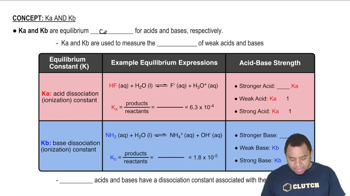
Characteristics of Ka and Kb

Strength of Acids

The strength of an acid is determined by its ability to donate protons (H+) in an aqueous solution. Strong acids, such as hydrochloric acid (HCl), dissociate completely, while weak acids, like acetic acid (CH3COOH), only partially dissociate. The relative strength of the acids represented in the diagrams can be inferred from their molecular structures and the presence of electronegative atoms that stabilize the conjugate base.
Video consigliato:
Percorso guidato
03:51
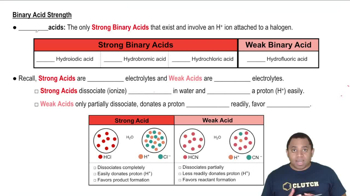
Binary Acid Strengths

Molecular Structure and Electronegativity

The molecular structure of an acid, including the presence of electronegative atoms, significantly influences its acidity. Electronegativity affects the stability of the conjugate base formed after dissociation; more electronegative atoms can stabilize negative charge better, leading to a stronger acid. Analyzing the diagrams, one can assess which acid has a structure that would likely result in a lower Ka value based on these principles.
Video consigliato:
Percorso guidato
02:10
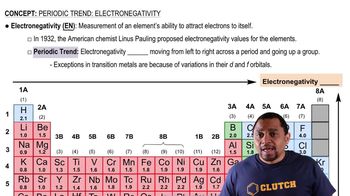
Electronegativity Trends
Pratica correlata
Domanda del libro di testo

The probe of the pH meter shown here is sitting in a beaker that contains a clear liquid. You are told the liquid is pure water, a solution of HCl(aq), or a solution of KOH(aq). (b) If the liquid is one of the solutions, what is its molarity?

1100
views
Domanda del libro di testo

The following diagrams represent aqueous solutions of three acids, HX, HY, and HZ. The water molecules have been omitted for clarity, and the hydrated proton is represented as H+ rather than H3O+.(c) Which solution would have the highest pH?

1943
views
1
rank
Domanda del libro di testo

Each of the three molecules shown here contains an OH group, but one molecule acts as a base, one as an acid, and the third is neither acid nor base. (c) Which one is neither acidic nor basic?

665
views
Domanda del libro di testo

Phenylephrine, an organic substance with molecular formula C9H13NO2, is used as a nasal decongenstant in over-thecounter medications. The molecular structure of phenylephrine is shown below using the usual shortcut organic structure. (a) Would you expect a solution of phenylephrine to be acidic, neutral, or basic?

943
views
Domanda del libro di testo

The following diagrams represent aqueous solutions of three acids, HX, HY, and HZ. The water molecules have been omitted for clarity, and the hydrated proton is represented as H+ rather than H3O+. (a) Which of the acids is a strong acid? Explain.

588
views
Domanda del libro di testo

The probe of the pH meter shown here is sitting in a beaker that contains a clear liquid. (c) Why is the temperature given on the pH meter?

358
views
1
rank