Ch.16 - Acid-Base Equilibria
Brown - Chemistry: The Central Science 14th Edition
Brown14th EditionChemistry: The Central ScienceISBN: 9780134414232Non è quello che usi tu?Cambia libro di testo
Capitolo 16, Problema 106

What is the pH of a solution that is 2.5 * 10^-9 M in NaOH? Does your answer make sense? What assumption do we normally make that is not valid in this case?

Guida verificata passo dopo passo
1
Step 1: Recognize that NaOH is a strong base and will dissociate completely in water to produce OH⁻ ions. Therefore, the concentration of OH⁻ ions in the solution is 2.5 \(\times\) 10^{-9} \(\text{ M}\).
Step 2: Calculate the pOH of the solution using the formula \( \text{pOH} = -\log[\text{OH}^-] \). Substitute the concentration of OH⁻ ions into this formula.
Step 3: Use the relationship between pH and pOH, which is \( \text{pH} + \text{pOH} = 14 \), to find the pH of the solution.
Step 4: Consider the contribution of OH⁻ ions from the autoionization of water, which is significant in this case because the concentration of NaOH is very low. The concentration of OH⁻ from water is \( 1.0 \times 10^{-7} \text{ M} \).
Step 5: Recalculate the total OH⁻ concentration by adding the OH⁻ from NaOH and the OH⁻ from water. Use this total concentration to find the correct pOH and then the pH.

Concetti chiave

Ecco i concetti essenziali che devi comprendere per rispondere correttamente alla domanda.

pH Scale

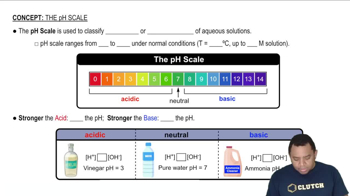
The pH scale measures the acidity or basicity of a solution, ranging from 0 to 14. A pH of 7 is neutral, below 7 indicates acidity, and above 7 indicates basicity. The pH is calculated as the negative logarithm of the hydrogen ion concentration, pH = -log[H+]. In basic solutions, the concentration of hydroxide ions (OH-) is higher, which inversely affects the hydrogen ion concentration.
Video consigliato:

Dissociation of Water

Water undergoes self-dissociation, producing equal concentrations of hydrogen ions (H+) and hydroxide ions (OH-). At 25°C, the concentration of H+ and OH- in pure water is 1.0 x 10^-7 M, leading to a neutral pH of 7. In very dilute solutions, such as the one in the question, the contribution of H+ from water becomes significant and must be considered when calculating pH.
Video consigliato:
Percorso guidato
04:52
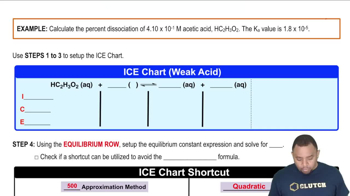
Percent Dissociation Example

Assumption of Dilute Solutions

In dilute solutions, it is often assumed that the contribution of H+ ions from the solute is much greater than that from water. However, in this case, the concentration of NaOH is so low (2.5 x 10^-9 M) that the H+ concentration from water (1.0 x 10^-7 M) becomes comparable, invalidating the assumption. This necessitates a more careful calculation of pH, taking both contributions into account.
Video consigliato:
Percorso guidato
01:03
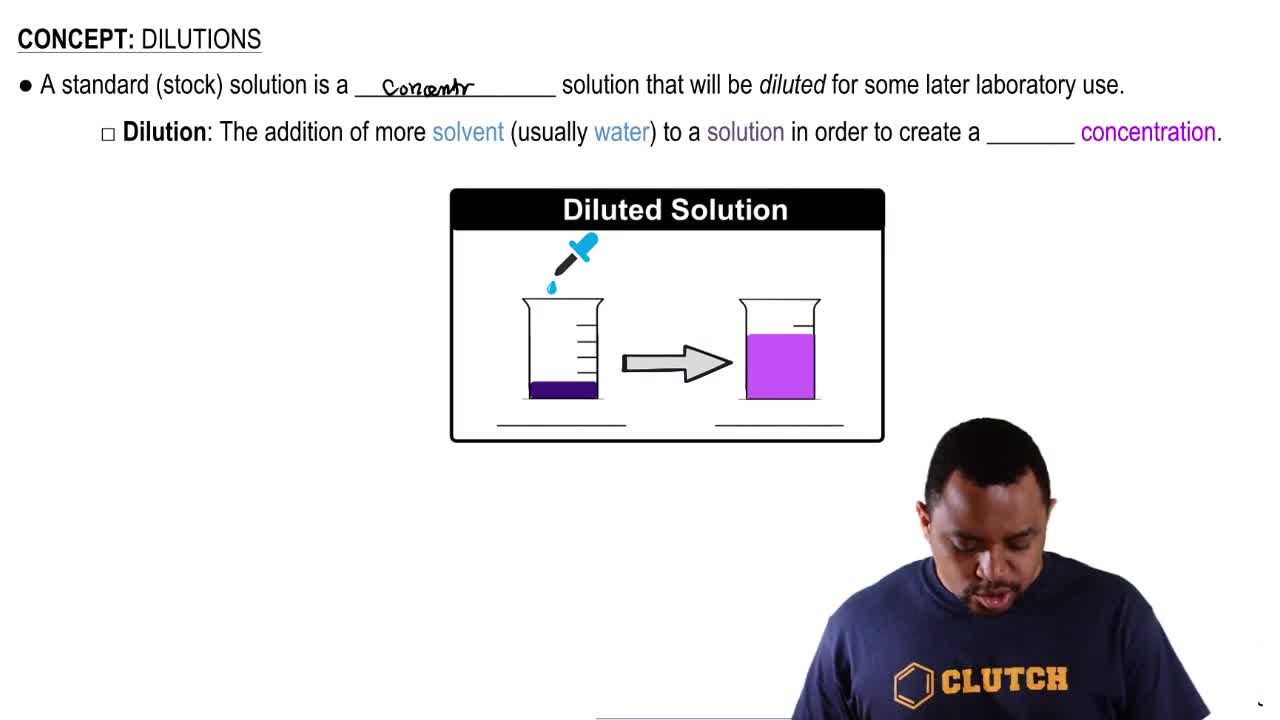
Solution Dilution Process