
The solubility product for Zn1OH22 is 3.0 * 10-16. The formation constant for the hydroxo complex, Zn1OH242 - , is 4.6 * 1017. What concentration of OH- is required to dissolve 0.015 mol of Zn1OH22 in a liter of solution?
Ch.17 - Additional Aspects of Aqueous Equilibria
Brown14th EditionChemistry: The Central ScienceISBN: 9780134414232Non è quello che usi tu?Cambia libro di testo
Tutti i libri di testo
Brown 14th Edition
Ch.17 - Additional Aspects of Aqueous Equilibria
Problema 110a
Brown 14th Edition
Ch.17 - Additional Aspects of Aqueous Equilibria
Problema 110aCapitolo 17, Problema 110a
(a) Write the net ionic equation for the reaction that occurs when a solution of hydrochloric acid (HCl) is mixed with a solution of sodium formate 1NaCHO22.
Guida verificata passo dopo passo1
Identify the reactants: Hydrochloric acid (HCl) and sodium formate (NaCHO_2).
Write the balanced molecular equation: HCl(aq) + NaCHO_2(aq) \(\rightarrow\) NaCl(aq) + HCHO_2(aq).
Dissociate all strong electrolytes into their ions: H^+(aq) + Cl^-(aq) + Na^+(aq) + CHO_2^-(aq) \(\rightarrow\) Na^+(aq) + Cl^-(aq) + HCHO_2(aq).
Identify the spectator ions: Na^+(aq) and Cl^-(aq) are present on both sides of the equation.
Write the net ionic equation by removing the spectator ions: H^+(aq) + CHO_2^-(aq) \(\rightarrow\) HCHO_2(aq).

Risposta video verificata per un problema simile:
Questa soluzione video è stata consigliata dai nostri tutor come utile per risolvere questo problema.
Durata del video:
4mConcetti chiave
Ecco i concetti essenziali che devi comprendere per rispondere correttamente alla domanda.
Net Ionic Equations
A net ionic equation represents the chemical species that are involved in a reaction, excluding spectator ions that do not participate in the reaction. It focuses on the actual chemical change occurring, providing a clearer picture of the reaction's essence. To write a net ionic equation, one must first write the balanced molecular equation, then dissociate the soluble strong electrolytes into their ions, and finally eliminate the spectator ions.
Video consigliato:
Percorso guidato
Net Ionic Equations
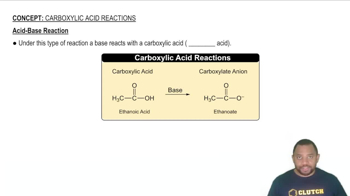
Acid-Base Reactions
Acid-base reactions involve the transfer of protons (H+) between reactants. In this context, hydrochloric acid (HCl) acts as a strong acid, fully dissociating in solution to release H+ ions. Sodium formate (NaCHO2) can act as a weak base, accepting protons. Understanding the behavior of acids and bases is crucial for predicting the products of their reactions.
Video consigliato:
Percorso guidato
Acid-Base Reaction
Dissociation of Electrolytes
Dissociation refers to the process by which an ionic compound separates into its constituent ions when dissolved in water. Strong electrolytes, like HCl and NaCHO2, dissociate completely in solution, while weak electrolytes do not. Recognizing which compounds dissociate and how they behave in solution is essential for writing accurate chemical equations and understanding the resulting ionic interactions.
Video consigliato:
Percorso guidato
Strong Acid Dissociation Example
Pratica correlata
Domanda del libro di testo
290
views
Domanda del libro di testo
The value of Ksp for Cd(OH)2 is 2.5 × 10⁻¹⁴. (a) What is the molar solubility of Cd(OH)2?
Domanda del libro di testo
(a) A 0.1044-g sample of an unknown monoprotic acid requires 22.10 mL of 0.0500 M NaOH to reach the end point. What is the molar mass of the unknown?
1774
views
Domanda del libro di testo
(b) As the acid is titrated, the pH of the solution after the addition of 11.05 mL of the base is 4.89. What is the Ka for the acid?
796
views
Domanda del libro di testo
The value of Ksp for Cd(OH)2 is 2.5 × 10⁻¹⁴. (b) The solubility of Cd(OH)2 can be increased through formation of the complex ion CdBr42- (Kf = 5 × 10³). If solid Cd(OH)2 is added to a NaBr solution, what is the initial concentration of NaBr needed to increase the molar solubility of Cd(OH)2 to 1.0 × 10⁻³ mol/L?
406
views