The solubility of CaCO3 is pH dependent. (b) Use the Kb expression for the CO32- ion to determine the equilibrium constant for the reaction CaCO3(s) + H2O(l) ⇌ Ca2+(aq) + HCO3-(aq) + OH-(aq)
Ch.17 - Additional Aspects of Aqueous Equilibria
Brown14th EditionChemistry: The Central ScienceISBN: 9780134414232Non è quello che usi tu?Cambia libro di testo
Tutti i libri di testo
Brown 14th Edition
Ch.17 - Additional Aspects of Aqueous Equilibria
Problema 97d
Brown 14th Edition
Ch.17 - Additional Aspects of Aqueous Equilibria
Problema 97dCapitolo 17, Problema 97d
Lead(II) carbonate, PbCO3, is one of the components of the passivating layer that forms inside lead pipes. (d) The EPA threshold for acceptable levels of lead ions in water is 15 ppb. Does a saturated solution of lead(II) carbonate produce a solution that exceeds the EPA limit?
Guida verificata passo dopo passo1
Step 1: Write the dissolution equation for lead(II) carbonate: PbCO_3(s) \(\rightleftharpoons\) Pb^{2+}(aq) + CO_3^{2-}(aq).
Step 2: Use the solubility product constant (K_{sp}) for PbCO_3 to express the equilibrium concentrations of the ions. The K_{sp} expression is K_{sp} = [Pb^{2+}][CO_3^{2-}].
Step 3: Assume the solubility of PbCO_3 is 's' mol/L. At equilibrium, [Pb^{2+}] = s and [CO_3^{2-}] = s. Substitute these into the K_{sp} expression to solve for 's'.
Step 4: Convert the solubility 's' from mol/L to ppb (parts per billion) for lead ions. Use the molar mass of lead to convert moles to grams, and then convert grams to ppb.
Step 5: Compare the calculated ppb of lead ions in the saturated solution to the EPA threshold of 15 ppb to determine if the solution exceeds the limit.

Risposta video verificata per un problema simile:
Questa soluzione video è stata consigliata dai nostri tutor come utile per risolvere questo problema.
Durata del video:
6mConcetti chiave
Ecco i concetti essenziali che devi comprendere per rispondere correttamente alla domanda.
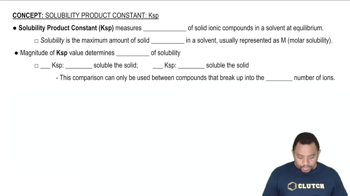
Solubility Product Constant (Ksp)
The solubility product constant (Ksp) is a numerical value that represents the extent to which a compound can dissolve in water. For lead(II) carbonate, PbCO3, Ksp can be used to determine the concentration of lead ions in a saturated solution. If the concentration of lead ions exceeds the EPA limit of 15 ppb, the solution is considered unsafe.
Video consigliato:
Percorso guidato
Solubility Product Constant
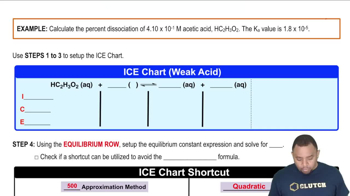
Lead(II) Carbonate Dissociation
Lead(II) carbonate dissociates in water to produce lead ions (Pb²⁺) and carbonate ions (CO3²⁻). The equilibrium established during this dissociation is crucial for calculating the concentration of lead ions in a saturated solution. Understanding this dissociation helps in assessing whether the lead concentration surpasses regulatory limits.
Video consigliato:
Percorso guidato
Percent Dissociation Example
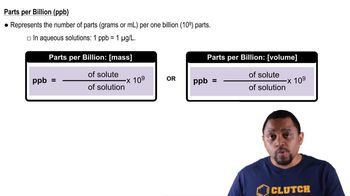
Parts Per Billion (ppb)
Parts per billion (ppb) is a unit of measurement used to express very dilute concentrations of substances. In the context of water quality, it indicates the number of parts of a substance per billion parts of water. The EPA's threshold of 15 ppb for lead ions is critical for determining the safety of drinking water, making it essential to compare the calculated lead concentration against this standard.
Video consigliato:
Percorso guidato
Parts per Billion (ppb)
Pratica correlata
Domanda del libro di testo
1551
views
Domanda del libro di testo
For each pair of compounds, use Ksp values to determine which has the greater molar solubility: (a) CdS or CuS (b) PbCO3 or BaCrO4 (c) Ni(OH)2 or NiCO3 (d) AgI or Ag2SO4.
773
views
Domanda del libro di testo
Suppose you want to do a physiological experiment that calls for a pH 6.50 buffer. You find that the organism with which you are working is not sensitive to the weak acid H2A 1Ka1 = 2 * 10-2; Ka2 = 5.0 * 10-72 or its sodium salts. You have available a 1.0 M solution of this acid and a 1.0 M solution of NaOH. How much of the NaOH solution should be added to 1.0 L of the acid to give a buffer at pH 6.50? (Ignore any volume change.)
647
views