
Ch.17 - Additional Aspects of Aqueous Equilibria
Brown - Chemistry: The Central Science 14th Edition
Brown14th EditionChemistry: The Central ScienceISBN: 9780134414232Non è quello che usi tu?Cambia libro di testo
Capitolo 17, Problema 95

Suppose you want to do a physiological experiment that calls for a pH 6.50 buffer. You find that the organism with which you are working is not sensitive to the weak acid H2A 1Ka1 = 2 * 10-2; Ka2 = 5.0 * 10-72 or its sodium salts. You have available a 1.0 M solution of this acid and a 1.0 M solution of NaOH. How much of the NaOH solution should be added to 1.0 L of the acid to give a buffer at pH 6.50? (Ignore any volume change.)

Guida verificata passo dopo passo
1
Identify the relevant equilibrium for the buffer system. Since the desired pH is 6.50, which is closer to the second pKa (7.2), use the second dissociation equilibrium: \( H_2A^- \rightleftharpoons HA^{2-} + H^+ \).
Use the Henderson-Hasselbalch equation for the second dissociation: \( \text{pH} = \text{pKa}_2 + \log \left( \frac{[HA^{2-}]}{[H_2A^-]} \right) \).
Substitute the given pH (6.50) and \( \text{pKa}_2 \) (7.2) into the Henderson-Hasselbalch equation to find the ratio \( \frac{[HA^{2-}]}{[H_2A^-]} \).
Calculate the moles of \( H_2A^- \) initially present in 1.0 L of 1.0 M \( H_2A \), which is 1.0 mol.
Determine the moles of NaOH needed to achieve the desired ratio by using the stoichiometry of the reaction \( H_2A^- + OH^- \rightarrow HA^{2-} + H_2O \), and solve for the volume of 1.0 M NaOH solution required.

Risposta video verificata per un problema simile:

Questa soluzione video è stata consigliata dai nostri tutor come utile per risolvere questo problema.
Durata del video:
7m

Concetti chiave

Ecco i concetti essenziali che devi comprendere per rispondere correttamente alla domanda.

Buffer Solutions

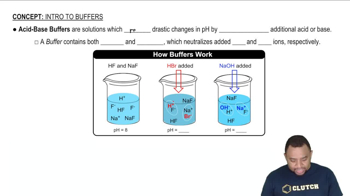
A buffer solution is a system that resists changes in pH upon the addition of small amounts of acid or base. It typically consists of a weak acid and its conjugate base or a weak base and its conjugate acid. In this case, the weak acid H2A and its sodium salt will help maintain the desired pH of 6.50 when NaOH is added.
Video consigliato:
Percorso guidato
03:02
Buffer Solutions

Henderson-Hasselbalch Equation

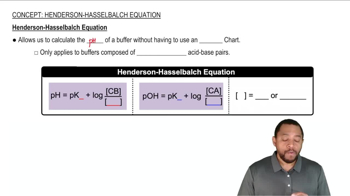
The Henderson-Hasselbalch equation relates the pH of a buffer solution to the concentration of its acid and conjugate base. It is expressed as pH = pKa + log([A-]/[HA]), where pKa is the negative logarithm of the acid dissociation constant (Ka). This equation is essential for calculating the required amounts of acid and base to achieve a specific pH.
Video consigliato:
Percorso guidato
02:40
Henderson-Hasselbalch Equation

Acid-Base Neutralization

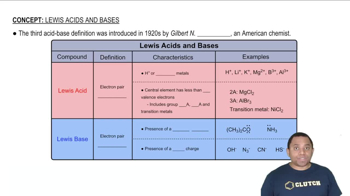
Acid-base neutralization is a chemical reaction where an acid reacts with a base to produce water and a salt. In this scenario, adding NaOH (a strong base) to the weak acid H2A will neutralize some of the acid, forming its conjugate base and adjusting the pH of the solution. Understanding this reaction is crucial for determining how much NaOH is needed to reach the target pH.
Video consigliato:
Percorso guidato
05:04
Lewis Acids and Bases