Ch.17 - Additional Aspects of Aqueous Equilibria
Brown - Chemistry: The Central Science 14th Edition
Brown14th EditionChemistry: The Central ScienceISBN: 9780134414232Non è quello che usi tu?Cambia libro di testo
Capitolo 17, Problema 38a

Predict whether the equivalence point of each of the following titrations is below, above, or at pH 7: (a) formic acid titrated with NaOH.

Guida verificata passo dopo passo
1
Identify the type of acid and base involved in the titration. Formic acid (HCOOH) is a weak acid, and NaOH is a strong base.
Understand that the equivalence point in a titration is where the amount of acid equals the amount of base added.
Recognize that when a weak acid is titrated with a strong base, the equivalence point will be above pH 7. This is because the conjugate base of the weak acid (formate ion, HCOO⁻) will hydrolyze in water to produce OH⁻ ions, making the solution basic.
Consider the reaction: HCOOH + OH⁻ → HCOO⁻ + H₂O. At the equivalence point, all the formic acid has been converted to its conjugate base, HCOO⁻.
Conclude that the equivalence point for the titration of formic acid with NaOH will be above pH 7 due to the basic nature of the solution at this point.

Risposta video verificata per un problema simile:

Questa soluzione video è stata consigliata dai nostri tutor come utile per risolvere questo problema.
Durata del video:
1m

Concetti chiave

Ecco i concetti essenziali che devi comprendere per rispondere correttamente alla domanda.

Acid-Base Titration

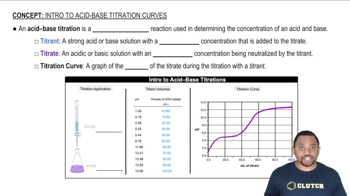
An acid-base titration is a quantitative analytical method used to determine the concentration of an acid or base in a solution. During the titration, a solution of known concentration (the titrant) is added to a solution of unknown concentration until the reaction reaches its equivalence point, where the amount of acid equals the amount of base. The pH at this point can vary depending on the nature of the acid and base involved.
Video consigliato:
Percorso guidato
03:04
Acid-Base Titration

Equivalence Point and pH

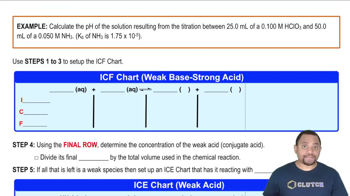
The equivalence point in a titration is the stage at which the number of moles of titrant equals the number of moles of the substance being titrated. The pH at the equivalence point is influenced by the strength of the acid and base. For strong acid-strong base titrations, the pH is typically 7, while for weak acid-strong base titrations, the pH is above 7, and for strong acid-weak base titrations, it is below 7.
Video consigliato:
Percorso guidato
07:28
pH at the Equivalence Point Example

Weak Acid Behavior

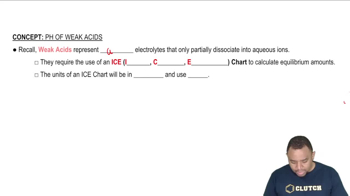
Formic acid is a weak acid, meaning it does not completely dissociate in solution. When titrated with a strong base like NaOH, the resulting solution at the equivalence point will contain the conjugate base of the weak acid, which can hydrolyze to produce hydroxide ions, leading to a pH greater than 7. This behavior is crucial for predicting the pH at the equivalence point in titrations involving weak acids.
Video consigliato:
Percorso guidato
00:44
ICE Charts of Weak Acids