Ch.17 - Additional Aspects of Aqueous Equilibria
Brown - Chemistry: The Central Science 14th Edition
Brown14th EditionChemistry: The Central ScienceISBN: 9780134414232Non è quello che usi tu?Cambia libro di testo
Capitolo 17, Problema 20

Which of the following solutions is a buffer? (a) A solution made by mixing 100 mL of 0.100 M CH3COOH and 50 mL of 0.100 M NaOH, (b) a solution made by mixing 100 mL of 0.100 M CH3COOH and 500 mL of 0.100 M NaOH, (c) A solution made by mixing 100 mL of 0.100 M CH3COOH and 50 mL of 0.100 M HCl, (d) A solution made by mixing 100 mL of 0.100 M CH3COOK and 50 mL of 0.100 M KCl.

Guida verificata passo dopo passo
1
Identify the components needed for a buffer solution: a weak acid and its conjugate base, or a weak base and its conjugate acid.
Analyze option (a): Calculate the moles of CH3COOH and NaOH. Determine if there is enough NaOH to partially neutralize CH3COOH, forming CH3COO- (acetate), the conjugate base.
Analyze option (b): Calculate the moles of CH3COOH and NaOH. Check if NaOH completely neutralizes CH3COOH, leaving no weak acid to form a buffer.
Analyze option (c): Calculate the moles of CH3COOH and HCl. Since HCl is a strong acid, it will not form a buffer with CH3COOH.
Analyze option (d): Check if CH3COOK (potassium acetate) and KCl can form a buffer. Note that KCl is a neutral salt and does not contribute to buffer formation.

Risposta video verificata per un problema simile:

Questa soluzione video è stata consigliata dai nostri tutor come utile per risolvere questo problema.

Concetti chiave

Ecco i concetti essenziali che devi comprendere per rispondere correttamente alla domanda.

Buffer Solutions

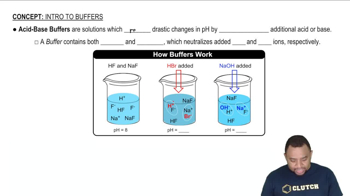
A buffer solution is a system that resists changes in pH upon the addition of small amounts of acid or base. It typically consists of a weak acid and its conjugate base or a weak base and its conjugate acid. This equilibrium allows the buffer to neutralize added acids or bases, maintaining a relatively stable pH.
Video consigliato:
Percorso guidato
03:02
Buffer Solutions

Weak Acids and Conjugate Bases

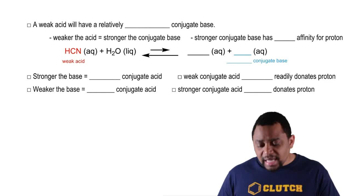
Weak acids, such as acetic acid (CH3COOH), partially dissociate in solution, establishing an equilibrium between the undissociated acid and its ions. The conjugate base, in this case, acetate (CH3COO-), can react with added hydrogen ions (H+) to minimize pH changes, making the combination of a weak acid and its conjugate base essential for buffer action.
Video consigliato:
Percorso guidato
01:46
Conjugate Acid-Base Relationships

Stoichiometry in Buffer Preparation

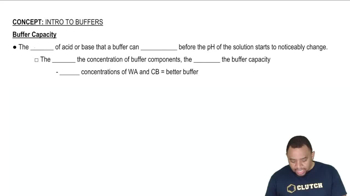
Stoichiometry involves the calculation of reactants and products in chemical reactions. In the context of buffer solutions, it is crucial to determine the ratios of weak acid to conjugate base. The effectiveness of a buffer depends on the concentrations of these components, which can be influenced by the volumes and molarities of the solutions mixed.
Video consigliato:
Percorso guidato
00:45
Buffer Capacity