
Ch.17 - Additional Aspects of Aqueous Equilibria
Brown - Chemistry: The Central Science 14th Edition
Brown14th EditionChemistry: The Central ScienceISBN: 9780134414232Non è quello che usi tu?Cambia libro di testo
Capitolo 17, Problema 26a

You are asked to prepare a pH = 4.00 buffer starting from 1.50 L of 0.0200 M solution of benzoic acid 1C6H5COOH2 and any amount you need of sodium benzoate 1C6H5COONa2. (a) What is the pH of the benzoic acid solution prior to adding sodium benzoate?

Guida verificata passo dopo passo
1
Identify the chemical species involved: benzoic acid (C6H5COOH) is a weak acid, and its dissociation in water can be represented as C6H5COOH ⇌ C6H5COO⁻ + H⁺.
Use the expression for the acid dissociation constant (Ka) for benzoic acid: Ka = [C6H5COO⁻][H⁺] / [C6H5COOH].
Look up the Ka value for benzoic acid, which is typically around 6.3 x 10⁻⁵.
Assume that the initial concentration of benzoic acid is 0.0200 M and that the change in concentration due to dissociation is small compared to the initial concentration.
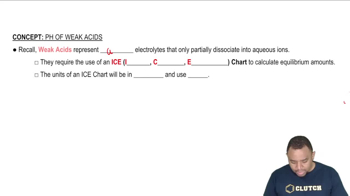
Set up an ICE (Initial, Change, Equilibrium) table to solve for the concentration of H⁺ ions at equilibrium, and then calculate the pH using the formula pH = -log[H⁺].

Risposta video verificata per un problema simile:

Questa soluzione video è stata consigliata dai nostri tutor come utile per risolvere questo problema.
Durata del video:
9m

Concetti chiave

Ecco i concetti essenziali che devi comprendere per rispondere correttamente alla domanda.

pH and pKa

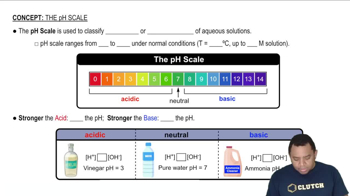
pH is a measure of the acidity or basicity of a solution, defined as the negative logarithm of the hydrogen ion concentration. The pKa is the negative logarithm of the acid dissociation constant (Ka) and indicates the strength of an acid. For weak acids like benzoic acid, the pH can be calculated using the formula pH = pKa + log([A-]/[HA]), where [A-] is the concentration of the conjugate base and [HA] is the concentration of the acid.
Video consigliato:

Benzoic Acid as a Weak Acid

Benzoic acid (C6H5COOH) is a weak acid that partially dissociates in solution. Its dissociation can be represented by the equation C6H5COOH ⇌ C6H5COO- + H+. The extent of this dissociation is characterized by its Ka value, which is relatively low, indicating that at equilibrium, the concentration of undissociated benzoic acid remains significant compared to its dissociated ions.
Video consigliato:
Percorso guidato
00:44
ICE Charts of Weak Acids

Buffer Solutions

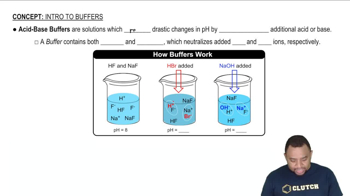
A buffer solution is a system that resists changes in pH upon the addition of small amounts of acid or base. It typically consists of a weak acid and its conjugate base, which can neutralize added acids or bases. In this case, the benzoic acid and sodium benzoate will form a buffer system, allowing the solution to maintain a stable pH when sodium benzoate is added.
Video consigliato:
Percorso guidato
03:02
Buffer Solutions