
Ch.17 - Additional Aspects of Aqueous Equilibria
Brown - Chemistry: The Central Science 14th Edition
Brown14th EditionChemistry: The Central ScienceISBN: 9780134414232Non è quello che usi tu?Cambia libro di testo
Capitolo 17, Problema 26b

You are asked to prepare a pH = 4.00 buffer starting from 1.50 L of 0.0200 M solution of benzoic acid 1C6H5COOH2 and any amount you need of sodium benzoate 1C6H5COONa2. (b) How many grams of sodium benzoate should be added to prepare the buffer? Neglect the small volume change that occurs when the sodium benzoate is added.

Guida verificata passo dopo passo
1
Identify the components of the buffer system: benzoic acid (C6H5COOH) and its conjugate base, sodium benzoate (C6H5COONa).
Use the Henderson-Hasselbalch equation for buffer solutions: \( \text{pH} = \text{pK}_a + \log \left( \frac{[\text{A}^-]}{[\text{HA}]} \right) \), where \([\text{A}^-]\) is the concentration of the conjugate base and \([\text{HA}]\) is the concentration of the acid.
Find the \(\text{pK}_a\) of benzoic acid from a reliable source. Typically, \(\text{pK}_a\) for benzoic acid is around 4.20.
Rearrange the Henderson-Hasselbalch equation to solve for the ratio \( \frac{[\text{A}^-]}{[\text{HA}]} \): \( \frac{[\text{A}^-]}{[\text{HA}]} = 10^{(\text{pH} - \text{pK}_a)} \). Substitute \(\text{pH} = 4.00\) and \(\text{pK}_a = 4.20\) to find the ratio.
Calculate the moles of benzoic acid in the solution: \( \text{moles of C6H5COOH} = 1.50 \text{ L} \times 0.0200 \text{ M} \). Use the ratio from the previous step to find the moles of sodium benzoate needed, then convert moles to grams using the molar mass of sodium benzoate (C6H5COONa).

Risposta video verificata per un problema simile:

Questa soluzione video è stata consigliata dai nostri tutor come utile per risolvere questo problema.
Durata del video:
10m

Concetti chiave

Ecco i concetti essenziali che devi comprendere per rispondere correttamente alla domanda.

Buffer Solutions

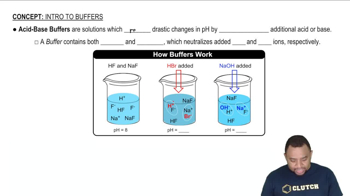
A buffer solution is a system that resists changes in pH upon the addition of small amounts of acid or base. It typically consists of a weak acid and its conjugate base, or a weak base and its conjugate acid. In this case, benzoic acid (weak acid) and sodium benzoate (conjugate base) form a buffer that can maintain a pH of 4.00.
Video consigliato:
Percorso guidato
03:02
Buffer Solutions

Henderson-Hasselbalch Equation

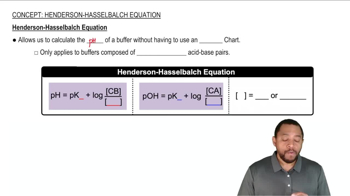
The Henderson-Hasselbalch equation relates the pH of a buffer solution to the concentration of its acid and conjugate base. It is expressed as pH = pKa + log([A-]/[HA]), where pKa is the negative logarithm of the acid dissociation constant. This equation is essential for calculating the required ratio of benzoate to benzoic acid to achieve the desired pH.
Video consigliato:
Percorso guidato
02:40
Henderson-Hasselbalch Equation

Molarity and Mass Calculations

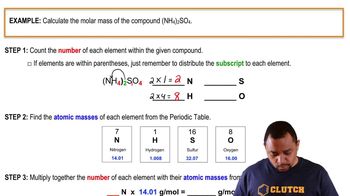
Molarity (M) is a measure of concentration defined as moles of solute per liter of solution. To find the mass of sodium benzoate needed, one must first determine the moles required using the Henderson-Hasselbalch equation, then convert moles to grams using the molar mass of sodium benzoate. This step is crucial for accurately preparing the buffer solution.
Video consigliato:
Percorso guidato
03:12
Molar Mass Calculation Example