For a certain chemical reaction, ΔH° = -35.4 kJ and ΔS° = -85.5 J/K. (b) Does the reaction lead to an increase or decrease in the randomness or disorder of the system?
Ch.19 - Chemical Thermodynamics
Brown14th EditionChemistry: The Central ScienceISBN: 9780134414232Non è quello che usi tu?Cambia libro di testo
Capitolo 19, Problema 56
A certain reaction has ΔH° = +23.7 kJ and ΔS° = +52.4 J>K. (c) Calculate ΔG° for the reaction at 298 K. (d) Is the reaction spontaneous at 298 K under standard conditions?
Guida verificata passo dopo passo1
Step 1: Understand the relationship between Gibbs free energy (ΔG°), enthalpy (ΔH°), and entropy (ΔS°) using the equation: ΔG° = ΔH° - TΔS°, where T is the temperature in Kelvin.
Step 2: Convert the entropy change (ΔS°) from J/K to kJ/K to match the units of ΔH°. Since 1 kJ = 1000 J, divide ΔS° by 1000.
Step 3: Substitute the given values into the equation: ΔH° = +23.7 kJ, ΔS° (converted to kJ/K), and T = 298 K.
Step 4: Calculate the term TΔS° by multiplying the temperature (298 K) by the converted ΔS° value.
Step 5: Substitute the values of ΔH° and TΔS° into the equation ΔG° = ΔH° - TΔS° to find ΔG°. Determine if the reaction is spontaneous by checking if ΔG° is negative.
Concetti chiave
Ecco i concetti essenziali che devi comprendere per rispondere correttamente alla domanda.
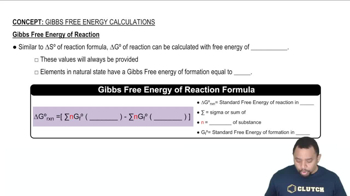
Gibbs Free Energy (ΔG)
Gibbs Free Energy (ΔG) is a thermodynamic potential that measures the maximum reversible work obtainable from a thermodynamic system at constant temperature and pressure. It is calculated using the equation ΔG = ΔH - TΔS, where ΔH is the change in enthalpy, T is the temperature in Kelvin, and ΔS is the change in entropy. A negative ΔG indicates a spontaneous reaction, while a positive ΔG suggests non-spontaneity.
Video consigliato:
Percorso guidato
Gibbs Free Energy of Reactions
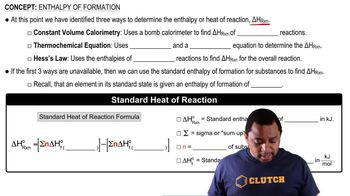
Enthalpy (ΔH)
Enthalpy (ΔH) is a measure of the total heat content of a system and reflects the energy required to break and form bonds during a chemical reaction. A positive ΔH indicates that the reaction is endothermic, meaning it absorbs heat from the surroundings. Understanding ΔH is crucial for predicting how energy changes influence the spontaneity of a reaction.
Video consigliato:
Percorso guidato
Enthalpy of Formation
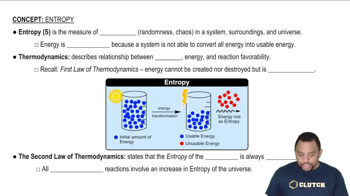
Entropy (ΔS)
Entropy (ΔS) is a measure of the disorder or randomness in a system. It quantifies the number of ways a system can be arranged, with higher entropy indicating greater disorder. In thermodynamics, an increase in entropy (positive ΔS) generally favors spontaneity, as systems tend to evolve towards states of higher disorder. The relationship between ΔS and temperature is essential for calculating ΔG.
Video consigliato:
Percorso guidato
Entropy in Thermodynamics
Pratica correlata
Domanda del libro di testo
647
views
Domanda del libro di testo
Use data in Appendix C to calculate ΔH°, ΔS°, and ΔG° at 25 °C for each of the following reactions.
a. 4 Cr(s) + 3 O2(g) → 2 Cr2O3(s)
b. BaCO3(s) → BaO(s) + CO2(g)
c. 2 P(s) + 10 HF(g) → 2 PF5(g) + 5 H2(g)
d. K(s) + O2(g) → KO2(s)
2561
views
Domanda del libro di testo
Using data from Appendix C, calculate ΔG° for the following reactions. Indicate whether each reaction is spontaneous at 298 K under standard conditions.
(a) 2 SO2(g) + O2(g) → 2 SO3(g)
(b) NO2(g) + N2O(g) → 3 NO(g)
(c) 6 Cl2(g) + 2 Fe2O3(s) → 4 FeCl3(s) + 3 O2(g)
(d) SO2(g) + 2 H2(g) → S(s) + 2 H2O(g)
1637
views
Domanda del libro di testo
For a certain chemical reaction, ΔH° = -35.4 kJ and ΔS° = -85.5 J/K. (c) Calculate ΔG° for the reaction at 298 K. (d) Is the reaction spontaneous at 298 K under standard conditions?
1
views