Ch.19 - Chemical Thermodynamics
Brown - Chemistry: The Central Science 14th Edition
Brown14th EditionChemistry: The Central ScienceISBN: 9780134414232Non è quello che usi tu?Cambia libro di testo
Capitolo 19, Problema 97b

(b) Based on your general chemical knowledge, predict which of these reactions will have K>1. (i) 2 Mg(s) + O2 (g) ⇌ 2 MgO(s) (ii) 2 KI(s) ⇌ 2 K(g) + I2(g) (iii) Na2(g) ⇌ 2 Na(g) (iv) 2 V2O5(s) ⇌ 4 V(s) + 5 O2(g)

Guida verificata passo dopo passo
1
Understand the concept of equilibrium constant (K): The equilibrium constant, K, indicates the extent to which a reaction proceeds to form products. If K > 1, the reaction favors the formation of products at equilibrium.
Analyze reaction (i): 2 Mg(s) + O_2(g) ⇌ 2 MgO(s). This is a combustion reaction where magnesium reacts with oxygen to form magnesium oxide, a stable compound. Such reactions typically have K > 1 as they favor product formation.
Analyze reaction (ii): 2 KI(s) ⇌ 2 K(g) + I_2(g). This reaction involves the decomposition of a solid into gaseous elements. Decomposition reactions of stable ionic solids like KI generally have K < 1, as they do not favor the formation of gaseous products.
Analyze reaction (iii): Na_2(g) ⇌ 2 Na(g). This reaction involves the dissociation of a diatomic molecule into atoms. The stability of Na_2 compared to individual Na atoms will determine K. Typically, such dissociation reactions have K < 1.
Analyze reaction (iv): 2 V_2O_5(s) ⇌ 4 V(s) + 5 O_2(g). This is a decomposition reaction of a stable oxide into its elements. Such reactions usually have K < 1, as they do not favor the formation of gaseous products from stable solids.

Risposta video verificata per un problema simile:

Questa soluzione video è stata consigliata dai nostri tutor come utile per risolvere questo problema.
Durata del video:
4m

Concetti chiave

Ecco i concetti essenziali che devi comprendere per rispondere correttamente alla domanda.

Equilibrium Constant (K)

The equilibrium constant (K) quantifies the ratio of the concentrations of products to reactants at equilibrium for a given reaction at a specific temperature. A K value greater than 1 indicates that products are favored at equilibrium, while a K value less than 1 suggests that reactants are favored. Understanding K helps predict the direction of a reaction and its extent.
Video consigliato:
Percorso guidato
01:14
Equilibrium Constant K

Gibbs Free Energy (ΔG)

Gibbs free energy (ΔG) is a thermodynamic potential that predicts the spontaneity of a reaction. A negative ΔG indicates that a reaction is spontaneous and will proceed in the forward direction, often correlating with a K value greater than 1. Conversely, a positive ΔG suggests non-spontaneity, aligning with a K value less than 1.
Video consigliato:
Percorso guidato
01:51
Gibbs Free Energy of Reactions

Phase States and Their Influence on K

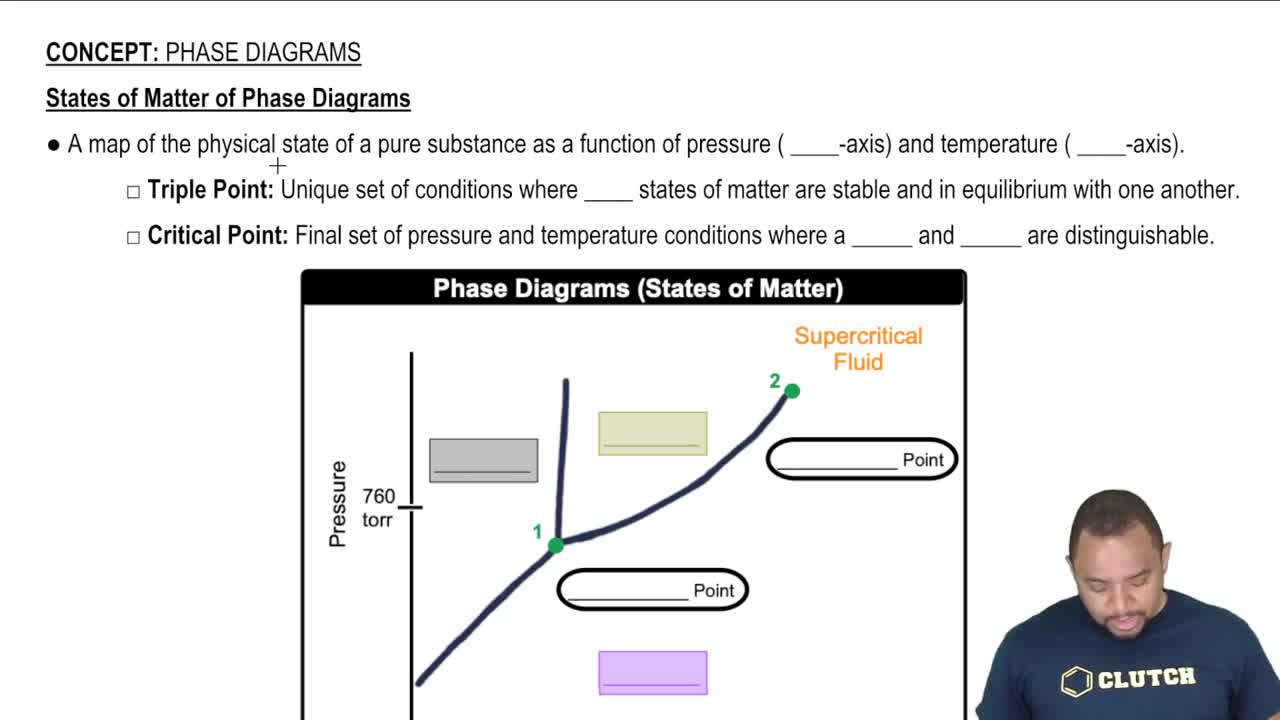
The phase states of reactants and products (solid, liquid, gas) significantly influence the equilibrium constant. Only gases and solutes in solution are included in the K expression, while solids and liquids are omitted. Recognizing the phase states helps in determining the correct K value and understanding how changes in conditions affect the equilibrium position.
Video consigliato:
Percorso guidato
03:19
States of Matter of Phase Diagrams
Pratica correlata
Domanda del libro di testo

(c) In each case, indicate whether K should increase or decrease with increasing temperature. (i) 2 Mg(s) + O2 (g) ⇌ 2 MgO(s) (ii) 2 KI(s) ⇌ 2 K(g) + I2(g) (iii) Na2(g) ⇌ 2 Na(g) (iv) 2 V2O5(s) ⇌ 4 V(s) + 5 O2(g)

Domanda del libro di testo

Using the data in Appendix C and given the pressures listed, calculate Kp and ΔG for each of the following reactions:

(a) N2(g) + 3 H2(g) → 2 NH3(g) PN2 = 2.6 atm, PH2 = 5.9 atm, PNH3 = 1.2 atm

(b) 2 N2H4(g) + 2 NO2(g) → 3 N2(g) + 4 H2O(g) PN2H4 = PNO2 = 5.0 × 10⁻² atm, PN2 = 0.5 atm, PH2O = 0.3 atm

(c) N2H4(g) → N2(g) + 2 H2(g) PN2H4 = 0.5 atm, PN2 = 1.5 atm, PH2 = 2.5 atm

807
views
Domanda del libro di testo

Consider the following three reactions: (i) Ti(s) + 2 Cl2(g) → TiCl4(1g) (ii) C2H6(g) + 7 Cl2(g) → 2 CCl4(g) + 6 HCl(g) (iii) BaO(s) + CO2(g) → BaCO3(s) (c) For each of the reactions, predict the manner in which the change in free energy varies with an increase in temperature.

371
views
Domanda del libro di testo

The oxidation of glucose (C6H12O6) in body tissue produces CO2 and H2O. In contrast, anaerobic decomposition, which occurs during fermentation, produces ethanol (C2H5OH) and CO2.

(a) Using data given in Appendix C, compare the equilibrium constants for the following reactions:

C6H12O6(s) + 6 O2(g) ⇌ 6 CO2(g) + 6 H2O(l)

C6H12O6(s) ⇌ 2 C2H5OH(l) + 2 CO2(g)

995
views
Domanda del libro di testo

(a) For each of the following reactions, predict the sign of ΔH° and ΔS° without doing any calculations. (i) 2 Mg(s) + O2 (g) ⇌ 2 MgO(s) (ii) 2 KI(s) ⇌ 2 K(g) + I2(g) (iii) Na2(g) ⇌ 2 Na(g) (iv) 2 V2O5(s) ⇌ 4 V(s) + 5 O2(g)

860
views