
Ch.19 - Chemical Thermodynamics
Brown - Chemistry: The Central Science 14th Edition
Brown14th EditionChemistry: The Central ScienceISBN: 9780134414232Non è quello che usi tu?Cambia libro di testo
Capitolo 19, Problema 95c

Consider the following three reactions: (i) Ti(s) + 2 Cl2(g) → TiCl4(1g) (ii) C2H6(g) + 7 Cl2(g) → 2 CCl4(g) + 6 HCl(g) (iii) BaO(s) + CO2(g) → BaCO3(s) (c) For each of the reactions, predict the manner in which the change in free energy varies with an increase in temperature.

Guida verificata passo dopo passo
1
Step 1: Understand the concept of Gibbs free energy change (ΔG) and its relation to temperature. The equation ΔG = ΔH - TΔS helps us predict how free energy changes with temperature, where ΔH is the change in enthalpy, T is the temperature, and ΔS is the change in entropy.
Step 2: Analyze reaction (i) Ti(s) + 2 Cl_2(g) → TiCl_4(l). Consider the states of matter: solid and gas to liquid. Generally, this reaction involves a decrease in entropy (ΔS < 0) because gases are converted to a liquid. If ΔH is negative (exothermic), increasing temperature will make ΔG less negative or more positive.
Step 3: Analyze reaction (ii) C_2H_6(g) + 7 Cl_2(g) → 2 CCl_4(g) + 6 HCl(g). This reaction involves gases on both sides, but the number of gas molecules decreases, suggesting a decrease in entropy (ΔS < 0). If ΔH is negative, increasing temperature will make ΔG less negative or more positive.
Step 4: Analyze reaction (iii) BaO(s) + CO_2(g) → BaCO_3(s). This reaction involves a gas being converted to a solid, indicating a decrease in entropy (ΔS < 0). If ΔH is negative, increasing temperature will make ΔG less negative or more positive.
Step 5: Conclude that for all three reactions, if they are exothermic (ΔH < 0), an increase in temperature will generally make ΔG less negative or more positive due to the negative ΔS, potentially making the reactions less spontaneous at higher temperatures.

Risposta video verificata per un problema simile:

Questa soluzione video è stata consigliata dai nostri tutor come utile per risolvere questo problema.
Durata del video:
4m

Concetti chiave

Ecco i concetti essenziali che devi comprendere per rispondere correttamente alla domanda.

Gibbs Free Energy

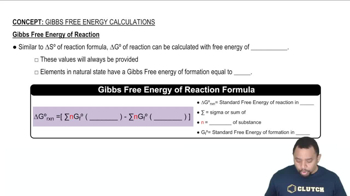
Gibbs Free Energy (G) is a thermodynamic potential that measures the maximum reversible work obtainable from a thermodynamic system at constant temperature and pressure. It is defined as G = H - TS, where H is enthalpy, T is temperature, and S is entropy. The change in Gibbs Free Energy (ΔG) indicates the spontaneity of a reaction: if ΔG is negative, the reaction is spontaneous; if positive, it is non-spontaneous.
Video consigliato:
Percorso guidato
01:51
Gibbs Free Energy of Reactions

Temperature Dependence of Free Energy

The temperature dependence of Gibbs Free Energy is significant because it affects both enthalpy and entropy. As temperature increases, the TΔS term becomes more influential. For reactions where entropy increases (ΔS > 0), higher temperatures can favor spontaneity, while for reactions with negative entropy changes (ΔS < 0), higher temperatures may hinder spontaneity, leading to a positive ΔG.
Video consigliato:
Percorso guidato
00:32
Standard Gibbs Free Energy and Temperature

Reaction Types and Their Characteristics

The reactions presented include synthesis and decomposition reactions, each with distinct characteristics. Synthesis reactions, like Ti + Cl2 → TiCl4, typically release energy and may have negative ΔG at lower temperatures. In contrast, reactions involving gaseous reactants and products, such as C2H6 + Cl2 → CCl4 + HCl, can have varying ΔS values, influencing how ΔG changes with temperature. Understanding these characteristics is crucial for predicting the behavior of free energy with temperature.
Video consigliato:
Percorso guidato
02:25
Common Types of Alkane Reactions
Pratica correlata
Domanda del libro di testo

Using the data in Appendix C and given the pressures listed, calculate Kp and ΔG for each of the following reactions:

(a) N2(g) + 3 H2(g) → 2 NH3(g) PN2 = 2.6 atm, PH2 = 5.9 atm, PNH3 = 1.2 atm

(b) 2 N2H4(g) + 2 NO2(g) → 3 N2(g) + 4 H2O(g) PN2H4 = PNO2 = 5.0 × 10⁻² atm, PN2 = 0.5 atm, PH2O = 0.3 atm

(c) N2H4(g) → N2(g) + 2 H2(g) PN2H4 = 0.5 atm, PN2 = 1.5 atm, PH2 = 2.5 atm

807
views
Domanda del libro di testo

Consider the following three reactions: (i) Ti(s) + 2 Cl2(g) → TiCl4(1g) (a) For each of the reactions, use data in Appendix C to calculate ΔH°, ΔG°, K, and ΔS ° at 25 °C.

312
views
Domanda del libro di testo

Consider the following three reactions: (i) Ti(s) + 2 Cl2(g) → TiCl4(1g) (ii) C2H6(g) + 7 Cl2(g) → 2 CCl4(g) + 6 HCl(g) (iii) BaO(s) + CO2(g) → BaCO3(s) (b) Which of these reactions are spontaneous under standard conditions at 25 °C?

1
views
Domanda del libro di testo

(a) For each of the following reactions, predict the sign of ΔH° and ΔS° without doing any calculations. (i) 2 Mg(s) + O2 (g) ⇌ 2 MgO(s) (ii) 2 KI(s) ⇌ 2 K(g) + I2(g) (iii) Na2(g) ⇌ 2 Na(g) (iv) 2 V2O5(s) ⇌ 4 V(s) + 5 O2(g)

860
views
Domanda del libro di testo

(b) Based on your general chemical knowledge, predict which of these reactions will have K>1. (i) 2 Mg(s) + O2 (g) ⇌ 2 MgO(s) (ii) 2 KI(s) ⇌ 2 K(g) + I2(g) (iii) Na2(g) ⇌ 2 Na(g) (iv) 2 V2O5(s) ⇌ 4 V(s) + 5 O2(g)

369
views
Domanda del libro di testo

(c) In general, under which condition is ΔG°f more positive (less negative) than ΔH°f ? (i) When the temperature is high, (ii) when the reaction is reversible, (iii) when ΔS°f is negative.

582
views