
Ch.19 - Chemical Thermodynamics
Brown - Chemistry: The Central Science 14th Edition
Brown14th EditionChemistry: The Central ScienceISBN: 9780134414232Non è quello che usi tu?Cambia libro di testo
Capitolo 19, Problema 17b

Consider a process in which an ideal gas changes from state 1 to state 2 in such a way that its temperature changes from 300 K to 200 K. (b) Is this process isothermal?

Guida verificata passo dopo passo
1
insert step 1: Understand the definition of an isothermal process. An isothermal process is one in which the temperature of the system remains constant throughout the process.
insert step 2: Identify the initial and final temperatures of the gas in the given problem. The temperature changes from 300 K to 200 K.
insert step 3: Compare the initial and final temperatures. Since the temperature changes from 300 K to 200 K, there is a change in temperature.
insert step 4: Determine if the process is isothermal. Since the temperature changes, the process is not isothermal.
insert step 5: Conclude that the process is not isothermal because the temperature does not remain constant.

Risposta video verificata per un problema simile:

Questa soluzione video è stata consigliata dai nostri tutor come utile per risolvere questo problema.
Durata del video:
1m

Concetti chiave

Ecco i concetti essenziali che devi comprendere per rispondere correttamente alla domanda.

Ideal Gas Law

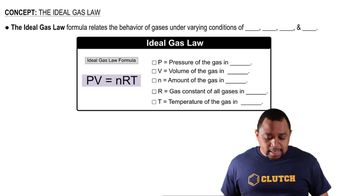
The Ideal Gas Law describes the relationship between pressure, volume, temperature, and the number of moles of an ideal gas. It is expressed as PV = nRT, where P is pressure, V is volume, n is the number of moles, R is the ideal gas constant, and T is temperature in Kelvin. Understanding this law is crucial for analyzing gas behavior during thermodynamic processes.
Video consigliato:
Percorso guidato
01:15
Ideal Gas Law Formula

Isothermal Process

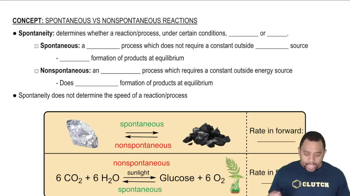
An isothermal process is a thermodynamic process in which the temperature of the system remains constant throughout the process. For an ideal gas, this means that any heat added to the system is used to do work, rather than changing the internal energy. In the context of the question, since the temperature changes from 300 K to 200 K, the process cannot be classified as isothermal.
Video consigliato:
Percorso guidato
04:20
Spontaneity of Processes

Thermodynamic States

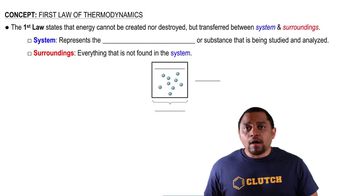
Thermodynamic states refer to the specific conditions of a system, characterized by properties such as temperature, pressure, and volume. Changes in these properties define the transition from one state to another. In the given question, the transition from state 1 at 300 K to state 2 at 200 K indicates a change in temperature, which is a key factor in determining the nature of the process.
Video consigliato:
Percorso guidato
01:18
First Law of Thermodynamics