Consider a process in which an ideal gas changes from state 1 to state 2 in such a way that its temperature changes from 300 K to 200 K. (b) Is this process isothermal?
Ch.19 - Chemical Thermodynamics
Brown14th EditionChemistry: The Central ScienceISBN: 9780134414232Non è quello che usi tu?Cambia libro di testo
Capitolo 19, Problema 17a
Consider a process in which an ideal gas changes from state 1 to state 2 in such a way that its temperature changes from 300 K to 200 K. (a) Does the temperature change depend on whether the process is reversible or irreversible?
Guida verificata passo dopo passo1
insert step 1> Understand that temperature is a state function, which means it depends only on the initial and final states of the system, not on the path taken to get from one to the other.
insert step 2> Recognize that in this problem, the temperature change is from 300 K to 200 K, which are the initial and final states.
insert step 3> Since temperature is a state function, the change in temperature (\( \Delta T \)) is the same regardless of whether the process is reversible or irreversible.
insert step 4> Conclude that the temperature change does not depend on the nature of the process (reversible or irreversible).
insert step 5> Reiterate that the key concept here is the state function property of temperature, which ensures that \( \Delta T = T_{final} - T_{initial} \) is path-independent.

Risposta video verificata per un problema simile:
Questa soluzione video è stata consigliata dai nostri tutor come utile per risolvere questo problema.
Durata del video:
2mConcetti chiave
Ecco i concetti essenziali che devi comprendere per rispondere correttamente alla domanda.
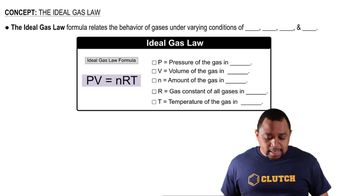
Ideal Gas Law
The Ideal Gas Law describes the relationship between pressure, volume, temperature, and the number of moles of an ideal gas. It is expressed as PV = nRT, where P is pressure, V is volume, n is the number of moles, R is the ideal gas constant, and T is temperature in Kelvin. Understanding this law is crucial for analyzing gas behavior during state changes.
Video consigliato:
Percorso guidato
Ideal Gas Law Formula
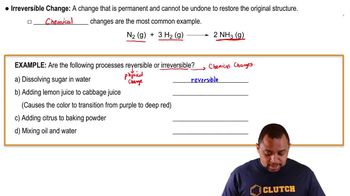
Reversible vs. Irreversible Processes
Reversible processes are idealized processes that can be reversed without any net change in the system or surroundings, while irreversible processes cannot return to their original state without external work. The distinction affects how energy is transferred and how temperature changes occur, but the temperature change itself is a state function and does not depend on the path taken.
Video consigliato:
Percorso guidato
Reversible vs Irreversible Example
State Functions
State functions are properties that depend only on the current state of a system, not on the path taken to reach that state. Examples include temperature, pressure, and volume. In the context of the question, the change in temperature from 300 K to 200 K is a state function, meaning it remains the same regardless of whether the process is reversible or irreversible.
Video consigliato:
Percorso guidato
Logarithmic Functions
Pratica correlata
Domanda del libro di testo
505
views
Domanda del libro di testo
Consider the vaporization of liquid water to steam at a pressure of 1 atm. (d) At what temperature are the two phases in equilibrium?
790
views
Domanda del libro di testo
The normal freezing point of n-octane (C8H18) is -57 °C. (b) In what temperature range is the freezing of n-octane a spontaneous process?
749
views
Domanda del libro di testo
Consider a process in which an ideal gas changes from state 1 to state 2 in such a way that its temperature changes from 300 K to 200 K. (c) Does the change in the internal energy, ΔE, depend on the particular pathway taken to carry out this change of state?
625
views
1
rank
Domanda del libro di testo
The normal freezing point of n-octane (C8H18) is -57 °C. (d) Is there any temperature at which liquid n-octane and solid n-octane are in equilibrium? Explain.
613
views