Indicate whether each statement is true or false. (a) A reaction that is spontaneous in one direction will be nonspontaneous in the reverse direction under the same reaction conditions. (b) All spontaneous processes are fast. (c) Most spontaneous processes are reversible. (d) An isothermal process is one in which the system loses no heat. (e) The maximum amount of work can be accomplished by an irreversible process rather than a reversible one.
Ch.19 - Chemical Thermodynamics
Brown14th EditionChemistry: The Central ScienceISBN: 9780134414232Non è quello che usi tu?Cambia libro di testo
Capitolo 19, Problema 15a
Consider the vaporization of liquid water to steam at a pressure of 1 atm. (a) Is this process endothermic or exothermic?
Guida verificata passo dopo passo1
Identify the process: Vaporization is the phase transition from liquid to gas.
Recall the energy requirement: Vaporization requires energy input to overcome intermolecular forces.
Determine the type of process: Since energy is absorbed from the surroundings, the process is endothermic.
Consider the system and surroundings: In an endothermic process, the system absorbs heat, causing the surroundings to cool down.
Conclude: The vaporization of liquid water to steam at 1 atm is an endothermic process.

Risposta video verificata per un problema simile:
Questa soluzione video è stata consigliata dai nostri tutor come utile per risolvere questo problema.
Durata del video:
3mConcetti chiave
Ecco i concetti essenziali che devi comprendere per rispondere correttamente alla domanda.
Endothermic and Exothermic Processes
Endothermic processes absorb heat from the surroundings, resulting in a temperature decrease in the environment. In contrast, exothermic processes release heat, causing an increase in the surrounding temperature. Understanding these definitions is crucial for determining the nature of a phase change, such as vaporization.
Video consigliato:
Percorso guidato
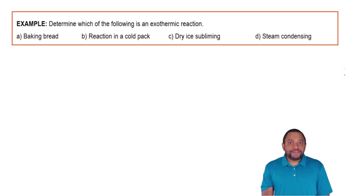
Endothermic & Exothermic Reactions Example 2
Phase Changes
Phase changes refer to the transitions between different states of matter, such as solid, liquid, and gas. Vaporization, specifically, is the transition from liquid to gas, which requires energy input to overcome intermolecular forces. Recognizing the energy dynamics involved in phase changes helps in identifying whether they are endothermic or exothermic.
Video consigliato:
Percorso guidato
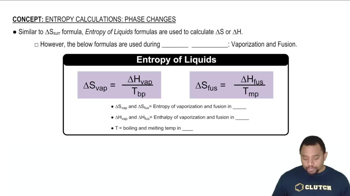
Entropy in Phase Changes
Latent Heat of Vaporization
The latent heat of vaporization is the amount of energy required to convert a unit mass of a liquid into vapor without a change in temperature. For water, this process at 1 atm pressure requires significant energy input, indicating that vaporization is an endothermic process. This concept is essential for understanding the energy requirements during phase transitions.
Video consigliato:
Percorso guidato
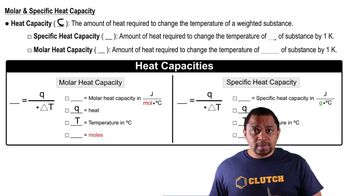
Heat Capacity
Pratica correlata
Domanda del libro di testo
931
views
Domanda del libro di testo
Consider the vaporization of liquid water to steam at a pressure of 1 atm. (d) At what temperature are the two phases in equilibrium?
790
views
Domanda del libro di testo
Consider the vaporization of liquid water to steam at a pressure of 1 atm. (b) In what temperature range is it a spontaneous process?
444
views
Domanda del libro di testo
(d) Does the amount of work that a system can do on its surroundings depend on the path of the process?
617
views
Domanda del libro di testo
Consider the vaporization of liquid water to steam at a pressure of 1 atm. (c) In what temperature range is it a nonspontaneous process?
361
views
