
Ch.19 - Chemical Thermodynamics
Brown - Chemistry: The Central Science 14th Edition
Brown14th EditionChemistry: The Central ScienceISBN: 9780134414232Non è quello che usi tu?Cambia libro di testo
Capitolo 19, Problema 68

Reactions in which a substance decomposes by losing CO are called decarbonylation reactions. The decarbonylation of acetic acid proceeds according to: CH3COOH(l) → CH3OH(g) + CO(g) By using data from Appendix C, calculate the minimum temperature at which this process will be spontaneous under standard conditions. Assume that ΔH° and ΔS° do not vary with temperature.

Guida verificata passo dopo passo
1
Identify the reaction: CH_3COOH(l) → CH_3OH(g) + CO(g).
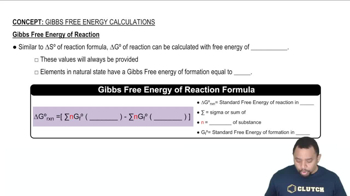
Use the Gibbs free energy equation: ΔG° = ΔH° - TΔS°.
For spontaneity, set ΔG° < 0, which implies ΔH° < TΔS°.
Calculate ΔH° for the reaction using standard enthalpies of formation: ΔH° = ΣΔH°_f(products) - ΣΔH°_f(reactants).
Calculate ΔS° for the reaction using standard entropies: ΔS° = ΣS°(products) - ΣS°(reactants).

Risposta video verificata per un problema simile:

Questa soluzione video è stata consigliata dai nostri tutor come utile per risolvere questo problema.
Durata del video:
11m

Concetti chiave

Ecco i concetti essenziali che devi comprendere per rispondere correttamente alla domanda.

Gibbs Free Energy

Gibbs Free Energy (ΔG) is a thermodynamic potential that helps predict the spontaneity of a reaction at constant temperature and pressure. A reaction is spontaneous when ΔG is negative, which can be calculated using the equation ΔG = ΔH - TΔS, where ΔH is the change in enthalpy, T is the temperature in Kelvin, and ΔS is the change in entropy.
Video consigliato:
Percorso guidato
01:51
Gibbs Free Energy of Reactions

Enthalpy and Entropy

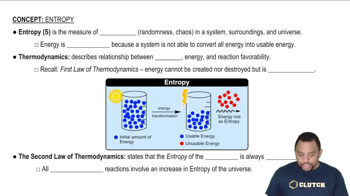
Enthalpy (ΔH) is a measure of the total heat content of a system, while entropy (ΔS) quantifies the degree of disorder or randomness in a system. In the context of decarbonylation reactions, understanding how these two thermodynamic properties change during the reaction is crucial for determining the conditions under which the reaction becomes spontaneous.
Video consigliato:
Percorso guidato
02:46
Entropy in Thermodynamics

Standard Conditions

Standard conditions refer to a set of specific conditions used as a reference point in thermodynamics, typically defined as 1 bar of pressure and a specified temperature, often 25°C (298 K). When calculating thermodynamic properties like ΔH and ΔS, it is essential to ensure that the values used are consistent with these standard conditions to accurately assess the spontaneity of the reaction.
Video consigliato:
Percorso guidato
01:10
Standard Reduction Potentials