Consider a reaction A2(𝑔) + B2(𝑔) ⇌ 2 AB(𝑔), atoms of A shown in red in the diagram and atoms of B shown in blue. (a) If 𝐾𝑐 = 1, which box represents the system at equilibrium?
Ch.19 - Chemical Thermodynamics
Brown14th EditionChemistry: The Central ScienceISBN: 9780134414232Non è quello che usi tu?Cambia libro di testo
Capitolo 19, Problema 7b
The accompanying diagram shows how ΔH (red line) and TΔS (blue line) change with temperature for a hypothetical reaction.
(b) In what temperature range is this reaction spontaneous?
Guida verificata passo dopo passo1
Understand the concept of spontaneity: A reaction is spontaneous when the change in Gibbs free energy (\( \Delta G \)) is negative. The equation for Gibbs free energy is \( \Delta G = \Delta H - T\Delta S \).
Identify the given variables: \( \Delta H \) is the change in enthalpy, \( T \) is the temperature in Kelvin, and \( \Delta S \) is the change in entropy.
Determine the relationship between \( \Delta H \) and \( T\Delta S \): For the reaction to be spontaneous, \( \Delta H < T\Delta S \).
Analyze the diagram: Look for the temperature range where the blue line (\( T\Delta S \)) is above the red line (\( \Delta H \)).
Conclude the temperature range: The reaction is spontaneous in the temperature range where the blue line is above the red line, indicating \( \Delta G < 0 \).

Risposta video verificata per un problema simile:
Questa soluzione video è stata consigliata dai nostri tutor come utile per risolvere questo problema.
Durata del video:
1mConcetti chiave
Ecco i concetti essenziali che devi comprendere per rispondere correttamente alla domanda.
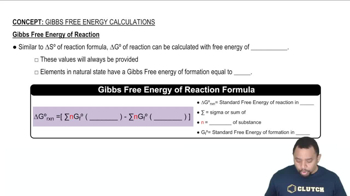
Gibbs Free Energy
Gibbs Free Energy (G) is a thermodynamic potential that helps predict the spontaneity of a reaction. A reaction is spontaneous when the change in Gibbs Free Energy (ΔG) is negative. The relationship is given by the equation ΔG = ΔH - TΔS, where ΔH is the change in enthalpy, T is the temperature in Kelvin, and ΔS is the change in entropy.
Video consigliato:
Percorso guidato
Gibbs Free Energy of Reactions
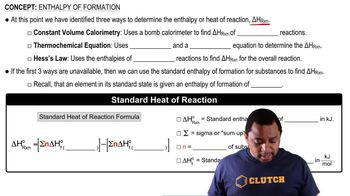
Enthalpy (ΔH)
Enthalpy (ΔH) is a measure of the total heat content of a system. In the context of a reaction, it indicates whether the reaction absorbs heat (endothermic, ΔH > 0) or releases heat (exothermic, ΔH < 0). The sign and magnitude of ΔH influence the spontaneity of the reaction, particularly at different temperatures.
Video consigliato:
Percorso guidato
Enthalpy of Formation
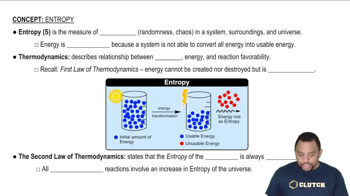
Entropy (ΔS)
Entropy (ΔS) is a measure of the disorder or randomness in a system. A positive change in entropy (ΔS > 0) indicates an increase in disorder, which favors spontaneity. The temperature (T) plays a crucial role in the Gibbs Free Energy equation, as higher temperatures can make a reaction spontaneous even if ΔH is positive, provided ΔS is also positive.
Video consigliato:
Percorso guidato
Entropy in Thermodynamics
Pratica correlata
Domanda del libro di testo
319
views
Domanda del libro di testo
Consider a reaction A2(𝑔) + B2(𝑔) ⇌ 2 AB(𝑔), atoms of A shown in red in the diagram and atoms of B shown in blue. (b) If 𝐾𝑐 = 1, which box represents the system at 𝑄 < 𝐾𝑐?
496
views
Domanda del libro di testo
Isomers are molecules that have the same chemical formula but different arrangements of atoms, as shown here for two isomers of pentane, C5H12.
(a) Do you expect a significant difference in the enthalpy of combustion of the two isomers? Explain.
1524
views
1
rank
Domanda del libro di testo
Isomers are molecules that have the same chemical formula but different arrangements of atoms, as shown here for two isomers of pentane, C5H12.
(b) Which isomer do you expect to have the higher standard molar entropy? Explain.
828
views