Ch.19 - Chemical Thermodynamics
Brown - Chemistry: The Central Science 14th Edition
Brown14th EditionChemistry: The Central ScienceISBN: 9780134414232Non è quello che usi tu?Cambia libro di testo
Capitolo 19, Problema 6b

Isomers are molecules that have the same chemical formula but different arrangements of atoms, as shown here for two isomers of pentane, C5H12.
(b) Which isomer do you expect to have the higher standard molar entropy? Explain.

Guida verificata passo dopo passo
1
Identify the structural differences between the two isomers of pentane, C5H12. Note how the atoms are arranged differently in each isomer.
Understand the concept of standard molar entropy, which is a measure of the randomness or disorder in a system. More complex molecular structures with greater freedom of movement typically have higher entropy.
Compare the complexity and branching of the isomers. Isomers with more branching generally have less freedom of movement because the branches restrict the rotation of the molecule's bonds.
Determine which isomer has less branching. This isomer will likely have higher standard molar entropy because its molecular structure allows for greater freedom of movement and more possible microstates.
Conclude that the isomer with the simpler, less branched structure typically has a higher standard molar entropy due to its increased molecular freedom compared to a more branched isomer.

Risposta video verificata per un problema simile:

Questa soluzione video è stata consigliata dai nostri tutor come utile per risolvere questo problema.
Durata del video:
2m

Concetti chiave

Ecco i concetti essenziali che devi comprendere per rispondere correttamente alla domanda.

Isomerism

Isomerism refers to the phenomenon where two or more compounds have the same molecular formula but differ in the arrangement of atoms. This can lead to distinct physical and chemical properties, as seen in structural isomers like the different forms of pentane. Understanding isomerism is crucial for predicting how these compounds will behave in various chemical contexts.
Video consigliato:
Percorso guidato
2:14
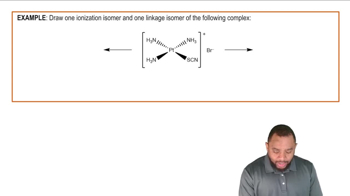
Isomerism in Coordination Complexes Example

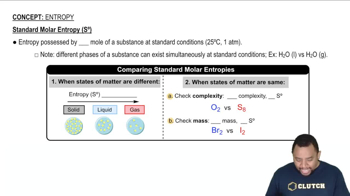
Standard Molar Entropy

Standard molar entropy is a measure of the amount of disorder or randomness in a system at standard conditions (1 bar and 25°C). It is an important thermodynamic property that reflects the number of accessible microstates for a given substance. Generally, more complex molecules with greater degrees of freedom and larger surface areas have higher entropies.
Video consigliato:
Percorso guidato
03:33
Standard Molar Entropy

Effect of Molecular Structure on Entropy

The molecular structure significantly influences the entropy of isomers. For instance, branched isomers tend to have lower entropy than their straight-chain counterparts due to reduced molecular motion and fewer conformations. In the case of pentane isomers, the straight-chain form typically exhibits higher entropy because it has more possible arrangements and interactions compared to its branched isomer.
Video consigliato:
Percorso guidato
02:35
Entropy and Physical Changes