
Ch.19 - Chemical Thermodynamics
Brown - Chemistry: The Central Science 14th Edition
Brown14th EditionChemistry: The Central ScienceISBN: 9780134414232Non è quello che usi tu?Cambia libro di testo
Capitolo 19, Problema 100c

The conversion of natural gas, which is mostly methane, into products that contain two or more carbon atoms, such as ethane (C2H6), is a very important industrial chemical process. In principle, methane can be converted into ethane and hydrogen: 2 CH4(g) → C2H6(g) + H2(g) In practice, this reaction is carried out in the presence of oxygen: 2 CH4(g) + 1/2 O2(g) → C2H6(g) + H2O(g) (c) Explain how the preceding reactions are an example of driving a nonspontaneous reaction, as discussed in the 'Chemistry and Life' box in Section 19.7.

Guida verificata passo dopo passo
1
1. The first reaction, 2 CH4(g) → C2H6(g) + H2(g), is nonspontaneous. This means it does not occur naturally without the input of energy. The conversion of methane to ethane and hydrogen requires a significant amount of energy to break the bonds in the methane molecules and form new bonds in the ethane and hydrogen molecules.
2. In order to make this reaction occur, we need to 'drive' it by providing the necessary energy. This is often done by coupling the nonspontaneous reaction with a spontaneous one. A spontaneous reaction is one that occurs naturally without the need for an input of energy.
3. The second reaction, 2 CH4(g) + 1/2 O2(g) → C2H6(g) + H2O(g), is an example of such a spontaneous reaction. The reaction of methane with oxygen to form ethane and water is exothermic, meaning it releases energy.
4. By carrying out the nonspontaneous reaction in the presence of oxygen, the energy released from the spontaneous reaction can be used to drive the nonspontaneous reaction. This is an example of how a nonspontaneous reaction can be driven by coupling it with a spontaneous reaction.
5. This concept is discussed in the 'Chemistry and Life' box in Section 19.7, where it is explained how nonspontaneous reactions are often driven in biological systems by coupling them with spontaneous reactions.

Risposta video verificata per un problema simile:

Questa soluzione video è stata consigliata dai nostri tutor come utile per risolvere questo problema.
Durata del video:
4m

Concetti chiave

Ecco i concetti essenziali che devi comprendere per rispondere correttamente alla domanda.

Spontaneity of Reactions

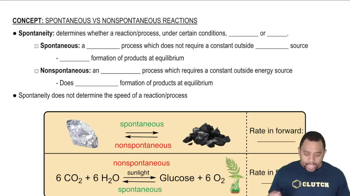
In thermodynamics, a spontaneous reaction is one that occurs without external intervention, typically characterized by a decrease in free energy. Nonspontaneous reactions, on the other hand, require an input of energy to proceed. Understanding the spontaneity of a reaction is crucial for determining whether a reaction can occur naturally or if it needs to be driven by external factors, such as heat or catalysts.
Video consigliato:
Percorso guidato
04:20
Spontaneity of Processes

Reaction Coupling

Reaction coupling involves linking a nonspontaneous reaction to a spontaneous one, allowing the overall process to proceed. In the context of the given reactions, the conversion of methane to ethane and hydrogen is nonspontaneous, but it can be driven by coupling it with the combustion of methane, which is spontaneous. This principle is often utilized in biochemical processes and industrial applications to facilitate desired reactions.
Video consigliato:
Percorso guidato
01:30
Alcohol Reactions: Dehydration Reactions

Role of Oxygen in Combustion

Oxygen plays a critical role in combustion reactions, acting as an oxidizing agent that facilitates the conversion of hydrocarbons into products like water and carbon dioxide. In the provided reaction, the presence of oxygen allows the nonspontaneous conversion of methane to ethane and hydrogen to occur by providing the necessary energy through combustion. This highlights the importance of reactants in driving chemical processes and altering reaction spontaneity.
Video consigliato:
Percorso guidato
02:24
Combustion Apparatus
Pratica correlata
Domanda del libro di testo

The oxidation of glucose (C6H12O6) in body tissue produces CO2 and H2O. In contrast, anaerobic decomposition, which occurs during fermentation, produces ethanol (C2H5OH) and CO2.

(b) Compare the maximum work that can be obtained from these processes under standard conditions.

C6H12O6(s) + 6 O2(g) ⇌ 6 CO2(g) + 6 H2O(l)

C6H12O6(s) ⇌ 2 C2H5OH(l) + 2 CO2(g)

627
views
Domanda del libro di testo

The potassium-ion concentration in blood plasma is about 5.0⨉10-3 M, whereas the concentration in muscle-cell fluid is much greater (0.15 M ). The plasma and intracellular fluid are separated by the cell membrane, which we assume is permeable only to K+. (a) What is ΔG for the transfer of 1 mol of K+ from blood plasma to the cellular fluid at body temperature 37 °C? (b) What is the minimum amount of work that must be used to transfer this K+?

1097
views
1
rank
Domanda del libro di testo

The oxidation of glucose (C6H12O6) in body tissue produces CO2 and H2O. In contrast, anaerobic decomposition, which occurs during fermentation, produces ethanol (C2H5OH) and CO2.

(a) Using data given in Appendix C, compare the equilibrium constants for the following reactions:

C6H12O6(s) + 6 O2(g) ⇌ 6 CO2(g) + 6 H2O(l)

C6H12O6(s) ⇌ 2 C2H5OH(l) + 2 CO2(g)

995
views
Domanda del libro di testo
In chemical kinetics, the entropy of activation is the entropy change for the process in which the reactants reach the activated complex. Predict whether the entropy of activation for a bimolecular process is usually positive or negative.
1493
views
Domanda del libro di testo

The conversion of natural gas, which is mostly methane, into products that contain two or more carbon atoms, such as ethane (C2H6), is a very important industrial chemical process. In principle, methane can be converted into ethane and hydrogen: 2 CH4(g) → C2H6(g) + H2(g) In practice, this reaction is carried out in the presence of oxygen: 2 CH4(g) + 12 O2(g) → C2H6(g) + H2O(g) (b) Is the difference in ΔG° for the two reactions due primarily to the enthalpy term (ΔH) or the entropy term (-TΔS)?

407
views