
Ch.19 - Chemical Thermodynamics
Brown - Chemistry: The Central Science 14th Edition
Brown14th EditionChemistry: The Central ScienceISBN: 9780134414232Non è quello che usi tu?Cambia libro di testo
Capitolo 19, Problema 60

Using data from Appendix C, calculate the change in Gibbs free energy for each of the following reactions. In each case, indicate whether the reaction is spontaneous at 298 K under standard conditions.
(a) 2 Ag(s) + Cl2(g) → 2 AgCl(s)
(b) P4O10(s) + 16 H2(g) → 4 PH3(g) + 10 H2O(g)
(c) CH4(g) + 4 F2(g) → CF4(g) + 4 HF(g)
(d) 2 H2O2(l) → 2 H2O(l) + O2(g)

Guida verificata passo dopo passo
1
Identify the standard Gibbs free energy of formation (ΔG_f^°) for each reactant and product from Appendix C for each reaction.
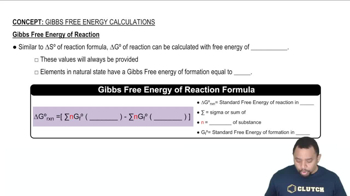
For each reaction, use the formula ΔG_rxn^° = Σ(ΔG_f^° products) - Σ(ΔG_f^° reactants) to calculate the standard Gibbs free energy change.
For reaction (a), calculate ΔG_rxn^° using the values for Ag(s), Cl2(g), and AgCl(s).
For reaction (b), calculate ΔG_rxn^° using the values for P4O10(s), H2(g), PH3(g), and H2O(g).
Determine the spontaneity of each reaction at 298 K by checking if ΔG_rxn^° is negative (spontaneous) or positive (non-spontaneous).

Risposta video verificata per un problema simile:

Questa soluzione video è stata consigliata dai nostri tutor come utile per risolvere questo problema.

Concetti chiave

Ecco i concetti essenziali che devi comprendere per rispondere correttamente alla domanda.

Gibbs Free Energy

Gibbs free energy (G) is a thermodynamic potential that measures the maximum reversible work obtainable from a thermodynamic system at constant temperature and pressure. It is calculated using the formula ΔG = ΔH - TΔS, where ΔH is the change in enthalpy, T is the temperature in Kelvin, and ΔS is the change in entropy. A negative ΔG indicates that a reaction is spontaneous under the given conditions.
Video consigliato:
Percorso guidato
01:51
Gibbs Free Energy of Reactions

Standard Conditions

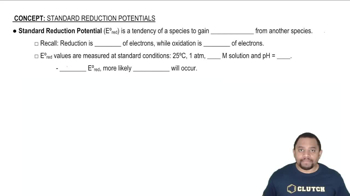
Standard conditions refer to a set of specific conditions used as a reference point in thermodynamics, typically defined as 1 bar of pressure and a specified temperature, usually 298 K (25°C). Under these conditions, the standard Gibbs free energy change (ΔG°) can be determined for reactions, allowing for the assessment of spontaneity and equilibrium. It is crucial to ensure that calculations are performed under these standardized conditions for consistency.
Video consigliato:
Percorso guidato
01:10
Standard Reduction Potentials

Spontaneity of Reactions

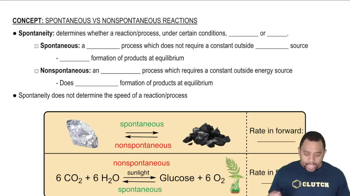
The spontaneity of a reaction indicates whether it can occur without external intervention. A reaction is considered spontaneous if it has a negative Gibbs free energy change (ΔG < 0) at the specified conditions. Factors influencing spontaneity include enthalpy changes (ΔH), entropy changes (ΔS), and temperature. Understanding these factors helps predict the direction of chemical reactions and their feasibility.
Video consigliato:
Percorso guidato
04:20
Spontaneity of Processes