
Ch.19 - Chemical Thermodynamics
Brown - Chemistry: The Central Science 14th Edition
Brown14th EditionChemistry: The Central ScienceISBN: 9780134414232Non è quello che usi tu?Cambia libro di testo
Capitolo 19, Problema 62a

Sulfur dioxide reacts with strontium oxide as follows: SO2(g) + SrO(g) → SrSO3(s) (a) Without using thermochemical data, predict whether ΔG° for this reaction is more negative or less negative than ΔH°.

Guida verificata passo dopo passo
1
Identify the type of reaction: The reaction between sulfur dioxide (SO_2) and strontium oxide (SrO) to form strontium sulfite (SrSO_3) is a combination reaction, where two reactants form a single product.
Consider the entropy change (ΔS°): In this reaction, two gaseous molecules (SO_2 and SrO) combine to form a solid (SrSO_3). This results in a decrease in entropy because gases have higher entropy than solids.
Relate ΔG° and ΔH° using the Gibbs free energy equation: ΔG° = ΔH° - TΔS°. Since ΔS° is negative (entropy decreases), the term -TΔS° becomes positive, which affects the relationship between ΔG° and ΔH°.
Predict the sign of ΔG° relative to ΔH°: Since -TΔS° is positive, ΔG° will be less negative than ΔH° if ΔH° is negative (exothermic reaction). If ΔH° is positive (endothermic reaction), ΔG° could be more positive or less negative than ΔH° depending on the magnitude of TΔS°.
Conclude the prediction: Without specific thermochemical data, the decrease in entropy suggests that ΔG° is likely less negative than ΔH° for this reaction, assuming it is exothermic.

Risposta video verificata per un problema simile:

Questa soluzione video è stata consigliata dai nostri tutor come utile per risolvere questo problema.
Durata del video:
1m

Concetti chiave

Ecco i concetti essenziali che devi comprendere per rispondere correttamente alla domanda.

Gibbs Free Energy (ΔG)

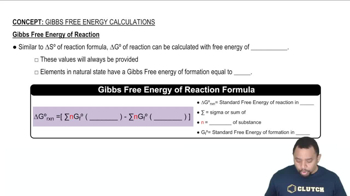
Gibbs Free Energy (ΔG) is a thermodynamic potential that measures the maximum reversible work obtainable from a thermodynamic system at constant temperature and pressure. It combines the system's enthalpy (ΔH) and entropy (ΔS) to determine spontaneity. A negative ΔG indicates a spontaneous reaction, while a positive ΔG suggests non-spontaneity.
Video consigliato:
Percorso guidato
01:51
Gibbs Free Energy of Reactions

Enthalpy (ΔH)

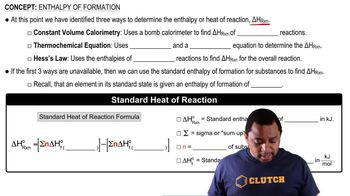
Enthalpy (ΔH) is a measure of the total heat content of a system, reflecting the energy required to create the system and the energy associated with the pressure and volume of the system. In chemical reactions, ΔH can be either positive (endothermic) or negative (exothermic), influencing the overall energy change during the reaction. Understanding ΔH is crucial for predicting reaction behavior.
Video consigliato:
Percorso guidato
02:34
Enthalpy of Formation

Entropy (ΔS)

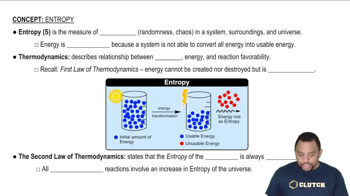
Entropy (ΔS) is a measure of the disorder or randomness in a system. In chemical reactions, an increase in entropy typically favors spontaneity, as systems tend to evolve towards greater disorder. The relationship between ΔG, ΔH, and ΔS is given by the equation ΔG = ΔH - TΔS, where T is the temperature in Kelvin, highlighting how entropy influences the Gibbs Free Energy.
Video consigliato:
Percorso guidato
02:46
Entropy in Thermodynamics
Pratica correlata
Domanda del libro di testo

Classify each of the following reactions as one of the four possible types summarized in Table 19.3: (i) spontanous at all temperatures; (ii) not spontaneous at any temperature; (iii) spontaneous at low T but not spontaneous at high T; (iv) spontaneous at high T but not spontaneous at low T.

(a) N2(g) + 3 F2(g) → 2 NF3(g) ΔH° = -249 kJ; ΔS° = -278 J/K

(b) N2(g) + 3 Cl2(g) → 2 NCl3(g) ΔH° = 460 kJ; ΔS° = -275 J/K

Domanda del libro di testo

Using data from Appendix C, calculate the change in Gibbs free energy for each of the following reactions. In each case, indicate whether the reaction is spontaneous at 298 K under standard conditions.

(a) 2 Ag(s) + Cl2(g) → 2 AgCl(s)

(b) P4O10(s) + 16 H2(g) → 4 PH3(g) + 10 H2O(g)

(c) CH4(g) + 4 F2(g) → CF4(g) + 4 HF(g)

(d) 2 H2O2(l) → 2 H2O(l) + O2(g)

Domanda del libro di testo

Classify each of the following reactions as one of the four possible types summarized in Table 19.3: (i) spontaneous at all temperatures; (ii) not spontaneous at any temperature; (iii) spontaneous at low T but not spontaneous at high T; (iv) spontaneous at high T but not spontaneous at low T.

(c) N2F4(g) ⟶ 2 NF2(g) ΔH° = 85 kJ; ΔS° = 198 J/K

839
views
Domanda del libro di testo

From the values given for ΔH° and ΔS°, calculate ΔG° for each of the following reactions at 298 K. If the reaction is not spontaneous under standard conditions at 298 K, at what temperature (if any) would the reaction become spontaneous?

a. 2 PbS(s) + 3 O2(g) → 2 PbO(s) + 2 SO2(g) ΔH° = −844 kJ; ΔS° = −165 J/K

b. 2 POCl3(g) → 2 PCl3(g) + O2(g) ΔH° = 572 kJ; ΔS° = 179 J/K

2787
views
1
rank
1
comments