Ch.2 - Atoms, Molecules, and Ions
Brown - Chemistry: The Central Science 14th Edition
Brown14th EditionChemistry: The Central ScienceISBN: 9780134414232Non è quello che usi tu?Cambia libro di testo
Capitolo 2, Problema 37a

(a) Thomson's cathode-ray tube (Figure 2.4) and the mass spectrometer (Figure 2.11) both involve the use of electric or magnetic fields to deflect charged particles. What are the charged particles involved in each of these experiments?

Guida verificata passo dopo passo
1
Identify the charged particles in Thomson's cathode-ray tube experiment. These are electrons, which are negatively charged particles.
Understand that in Thomson's experiment, the cathode rays are streams of electrons emitted from the cathode in a vacuum tube.
Recognize that in a mass spectrometer, the charged particles are ions. These ions can be positively or negatively charged, depending on the type of mass spectrometer and the sample being analyzed.
In a mass spectrometer, ions are generated from the sample and then accelerated through electric and magnetic fields, which separate them based on their mass-to-charge ratio.
Compare the two experiments: Thomson's cathode-ray tube focuses on the deflection of electrons, while the mass spectrometer focuses on the deflection and separation of ions based on their mass-to-charge ratio.

Risposta video verificata per un problema simile:

Questa soluzione video è stata consigliata dai nostri tutor come utile per risolvere questo problema.
Durata del video:
7m

Concetti chiave

Ecco i concetti essenziali che devi comprendere per rispondere correttamente alla domanda.

Cathode Rays

Cathode rays are streams of electrons emitted from the cathode in a vacuum tube. In Thomson's cathode-ray tube experiment, these negatively charged particles are deflected by electric and magnetic fields, allowing for the determination of their charge-to-mass ratio. This experiment was pivotal in the discovery of the electron as a fundamental particle.
Video consigliato:
Percorso guidato
01:35
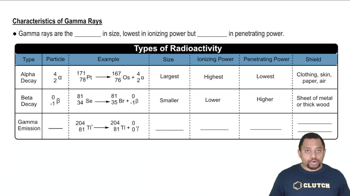
Characteristics of Gamma Rays

Mass Spectrometry

Mass spectrometry is an analytical technique used to measure the mass-to-charge ratio of ions. In a mass spectrometer, charged particles (ions) are generated and then subjected to electric and magnetic fields, which separate them based on their mass. This allows for the identification and quantification of different isotopes and molecules in a sample.
Video consigliato:

Electric and Magnetic Fields

Electric and magnetic fields are fundamental forces that can influence the motion of charged particles. In both Thomson's cathode-ray tube and mass spectrometry, these fields are used to manipulate the trajectory of electrons or ions, enabling scientists to study their properties. The deflection of these particles provides insights into their charge and mass, which are critical for understanding atomic structure.
Video consigliato:
Percorso guidato
02:40
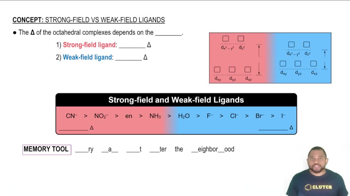
Strong-Field Ligands result in a large Δ and Weak-Field Ligands result in a small Δ.