
Ch.2 - Atoms, Molecules, and Ions
Brown - Chemistry: The Central Science 14th Edition
Brown14th EditionChemistry: The Central ScienceISBN: 9780134414232Non è quello che usi tu?Cambia libro di testo
Capitolo 2, Problema 37

(b) What are the labels on the axes of a mass spectrum? (c) To measure the mass spectrum of an atom, the atom must first lose one or more electrons. Which ion would you expect to be deflected more by the same setting of the electric and magnetic fields, a Cl+ or a Cl2+ ion?

Guida verificata passo dopo passo
1
To understand a mass spectrum, first recognize that it is a graph that displays the distribution of ions by their mass-to-charge ratio (m/z). Therefore, the x-axis of a mass spectrum is labeled as 'm/z' (mass-to-charge ratio), and the y-axis is labeled as 'Relative Abundance' or 'Intensity', which indicates how many ions are detected at each m/z value.
In a mass spectrometer, atoms or molecules are ionized to form charged particles. These ions are then accelerated through electric and magnetic fields, which separate them based on their mass-to-charge ratio.
For part (c), consider the deflection of ions in a mass spectrometer. The degree of deflection is influenced by the mass-to-charge ratio (m/z). A lower m/z ratio results in greater deflection because the ion is lighter or has a higher charge.
Compare the two ions: Cl+ and Cl2+. The Cl+ ion has a mass-to-charge ratio of approximately 35/1, while the Cl2+ ion has a mass-to-charge ratio of approximately 35/2. Since Cl2+ has a lower m/z ratio, it will be deflected more by the same electric and magnetic fields.
Thus, in a mass spectrometer, the Cl2+ ion would experience greater deflection compared to the Cl+ ion due to its lower mass-to-charge ratio, making it more responsive to the applied fields.

Concetti chiave

Ecco i concetti essenziali che devi comprendere per rispondere correttamente alla domanda.

Mass Spectrum Axes

In a mass spectrum, the x-axis typically represents the mass-to-charge ratio (m/z) of ions, while the y-axis indicates the relative abundance of these ions. The mass-to-charge ratio is crucial for identifying the mass of ions, as it reflects how much mass an ion has relative to its charge. This graphical representation allows chemists to analyze the composition of a sample based on the detected ions.
Video consigliato:
Percorso guidato
02:53
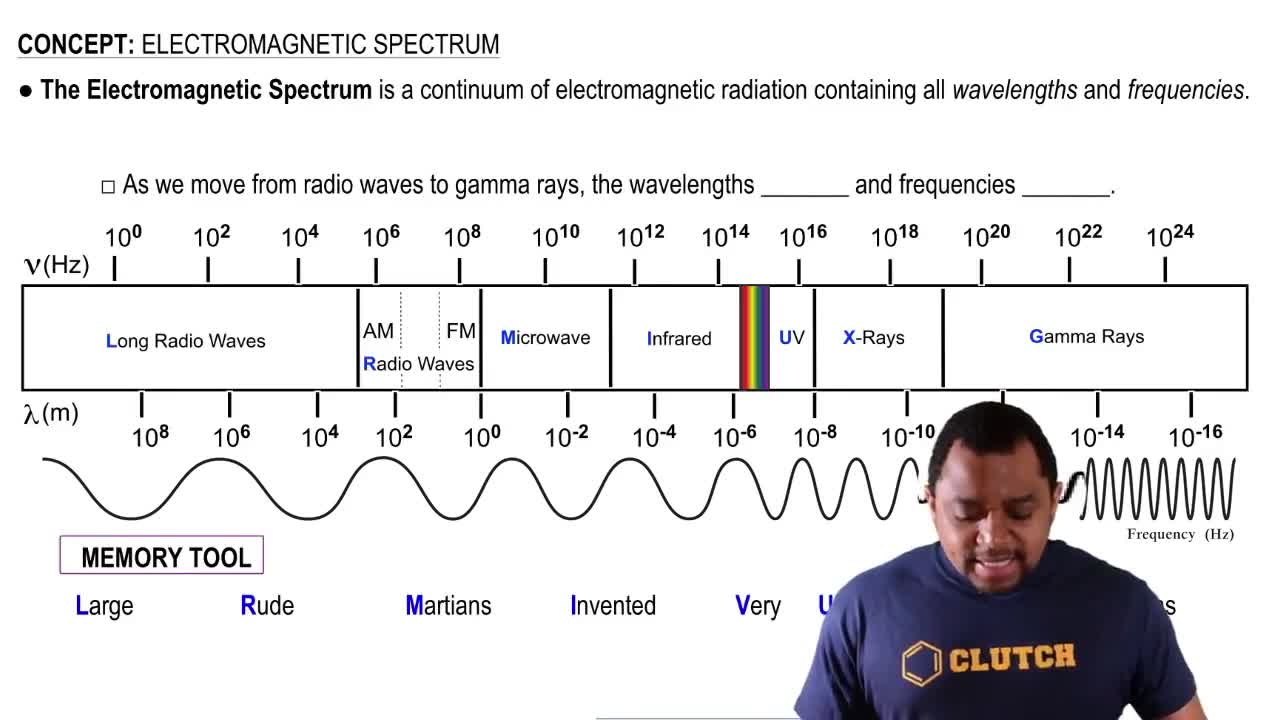
Electromagnetic Spectrum

Ionization and Charge

To obtain a mass spectrum, atoms must be ionized, meaning they lose one or more electrons, resulting in a positively charged ion. The charge of the ion affects its behavior in electric and magnetic fields, as ions with higher charges experience greater forces. This principle is essential for understanding how different ions, such as Cl+ and Cl2+, will respond to the same experimental conditions.
Video consigliato:
Percorso guidato
01:19
Ionization Energy

Deflection in Electric and Magnetic Fields

The deflection of ions in electric and magnetic fields is influenced by their mass and charge. According to the Lorentz force law, ions with a higher charge-to-mass ratio will be deflected more than those with a lower ratio. In the case of Cl+ and Cl2+, the Cl2+ ion, having a greater charge and a relatively lower mass per charge, would be expected to be deflected more than Cl+, making it crucial to consider these factors when predicting ion behavior.
Video consigliato:
Percorso guidato
02:40
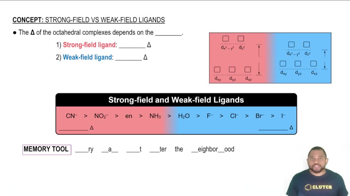
Strong-Field Ligands result in a large Δ and Weak-Field Ligands result in a small Δ.
Pratica correlata
Domanda del libro di testo

(a) Thomson's cathode-ray tube (Figure 2.4) and the mass spectrometer (Figure 2.11) both involve the use of electric or magnetic fields to deflect charged particles. What are the charged particles involved in each of these experiments?

657
views
1
rank
Domanda del libro di testo

Rubidium has two naturally occurring isotopes, rubidium-85 (atomic mass = 84.9118 amu; abundance = 72.15%) and rubidium-87 (atomic mass = 86.9092 amu; abundance = 27.85%). Calculate the atomic weight of rubidium

6608
views
Domanda del libro di testo

Consider the mass spectrometer shown in Figure 2.11. Determine whether each of the following statements is true or false. If false, correct the statement to make it true: (a) The paths of neutral (uncharged) atoms are not affected by the magnet.

567
views
Domanda del libro di testo

Only two isotopes of copper occur naturally: 63Cu (atomic mass = 62.9296 amu; abundance 69.17%) 65Cu (atomic mass = 64.9278 amu; abundance 30.83%). Calculate the atomic weight (average atomic mass) of copper.

4359
views
Domanda del libro di testo

(b) Why is the atomic weight of carbon reported as 12.011 in the table of elements and the periodic table in the front inside cover of this text?

1408
views
Domanda del libro di testo

Consider the mass spectrometer shown in Figure 2.11. Determine whether each of the following statements is true or false. If false, correct the statement to make it true: (b) The height of each peak in the mass spectrum is inversely proportional to the mass of that isotope.

532
views