Ch.2 - Atoms, Molecules, and Ions
Brown - Chemistry: The Central Science 14th Edition
Brown14th EditionChemistry: The Central ScienceISBN: 9780134414232Non è quello che usi tu?Cambia libro di testo
Capitolo 2, Problema 82b

(b) Among the four alkanes, ethane, propane, butane, and pentane, which is capable of existing in isomeric forms?

Guida verificata passo dopo passo
1
Identify the molecular formula for each alkane: ethane (C2H6), propane (C3H8), butane (C4H10), and pentane (C5H12).
Understand that isomers are compounds with the same molecular formula but different structural arrangements.
Recognize that alkanes with three or fewer carbon atoms (ethane and propane) cannot form isomers because there is only one way to arrange the carbon atoms in a straight chain.
Consider butane (C4H10), which can exist as two isomers: n-butane (a straight chain) and isobutane (a branched chain).
Consider pentane (C5H12), which can exist as three isomers: n-pentane (a straight chain), isopentane (a single branch), and neopentane (a more compact branched structure).

Risposta video verificata per un problema simile:

Questa soluzione video è stata consigliata dai nostri tutor come utile per risolvere questo problema.
Durata del video:
7m

Concetti chiave

Ecco i concetti essenziali che devi comprendere per rispondere correttamente alla domanda.

Isomerism

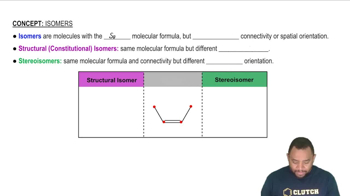
Isomerism refers to the phenomenon where two or more compounds have the same molecular formula but different structural arrangements or spatial orientations. This can lead to variations in physical and chemical properties. In organic chemistry, isomers can be classified into structural isomers, which differ in the connectivity of atoms, and stereoisomers, which differ in the spatial arrangement of atoms.
Video consigliato:
Percorso guidato
2:14
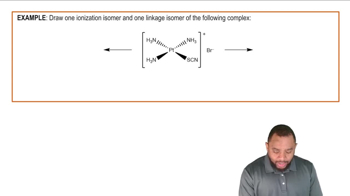
Isomerism in Coordination Complexes Example

Alkanes

Alkanes are a class of hydrocarbons characterized by single bonds between carbon atoms and a general formula of CnH2n+2. They are saturated compounds, meaning they contain the maximum number of hydrogen atoms per carbon atom. The simplest alkanes include methane, ethane, propane, butane, and pentane, with increasing carbon chain lengths leading to more complex structures.
Video consigliato:
Percorso guidato
01:20
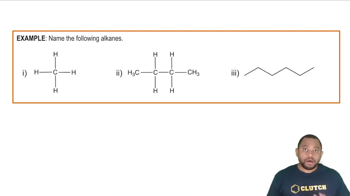
Naming Alkanes Example

Structural Isomers of Alkanes

Structural isomers of alkanes occur when alkanes with the same molecular formula can be arranged in different ways. For example, butane (C4H10) can exist as n-butane and isobutane, while pentane (C5H12) can have three structural isomers: n-pentane, isopentane, and neopentane. The ability to form isomers increases with the number of carbon atoms in the alkane, making it essential to identify which alkanes can exhibit this property.
Video consigliato: