Ch.2 - Atoms, Molecules, and Ions
Brown - Chemistry: The Central Science 14th Edition
Brown14th EditionChemistry: The Central ScienceISBN: 9780134414232Non è quello che usi tu?Cambia libro di testo
Capitolo 2, Problema 25b

(b) Which of these can vary without changing the identity of the element?

Guida verificata passo dopo passo
1
Identify the characteristics that define the identity of an element, such as the number of protons in the nucleus, which is also known as the atomic number.
Understand that the atomic number is unique to each element and determines the element's identity. Changing the atomic number would result in a different element.
Consider other properties of an atom, such as the number of neutrons and electrons, which can vary without changing the element's identity.
Recognize that isotopes are atoms of the same element that have different numbers of neutrons. This variation does not change the element itself, only its isotope.
Acknowledge that ions are atoms of the same element that have gained or lost electrons, resulting in a charge. This change in electrons does not alter the element's identity.

Risposta video verificata per un problema simile:

Questa soluzione video è stata consigliata dai nostri tutor come utile per risolvere questo problema.
Durata del video:
1m

Concetti chiave

Ecco i concetti essenziali che devi comprendere per rispondere correttamente alla domanda.

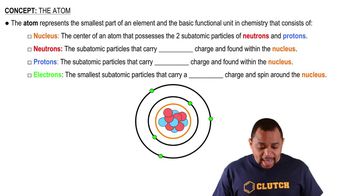
Atomic Number

The atomic number of an element is defined as the number of protons in its nucleus. This number is unique to each element and determines its identity. Changing the atomic number would result in a different element, so it cannot vary without changing the identity of the element.
Video consigliato:

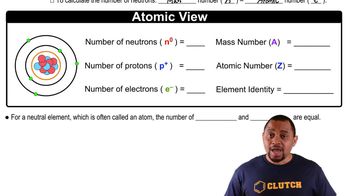
Isotopes

Isotopes are variants of a particular chemical element that have the same number of protons but different numbers of neutrons. This means that while their atomic number (and thus their identity as an element) remains the same, their mass and some physical properties can vary. Isotopes illustrate how variations in neutron count do not alter the fundamental identity of the element.
Video consigliato:

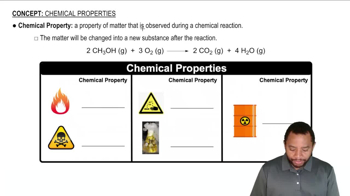
Chemical Properties

Chemical properties refer to the characteristics of a substance that become evident during a chemical reaction. These properties can vary based on the conditions or the presence of other substances, but they do not change the identity of the element itself. For example, the reactivity of an element can change under different conditions, yet it remains the same element.
Video consigliato:
Percorso guidato
03:31
Chemical Properties