Ch.2 - Atoms, Molecules, and Ions
Brown - Chemistry: The Central Science 14th Edition
Brown14th EditionChemistry: The Central ScienceISBN: 9780134414232Non è quello che usi tu?Cambia libro di testo
Capitolo 2, Problema 85a

Chloropropane is derived from propane by substituting Cl for H on one of the carbon atoms. (a) Draw the structural formulas for the two isomers of chloropropane.

Guida verificata passo dopo passo
1
Identify the structure of propane, which is C3H8, and consists of a three-carbon chain with hydrogen atoms filling the remaining valences.
Recognize that chloropropane is formed by replacing one hydrogen atom in propane with a chlorine atom (Cl).
Consider the possible positions for the chlorine atom: it can be attached to either the end carbon (1-chloropropane) or the middle carbon (2-chloropropane).
Draw the structural formula for 1-chloropropane: CH3-CH2-CH2Cl, where the Cl is attached to the first carbon.
Draw the structural formula for 2-chloropropane: CH3-CHCl-CH3, where the Cl is attached to the second carbon.

Risposta video verificata per un problema simile:

Questa soluzione video è stata consigliata dai nostri tutor come utile per risolvere questo problema.
Durata del video:
5m

Concetti chiave

Ecco i concetti essenziali che devi comprendere per rispondere correttamente alla domanda.

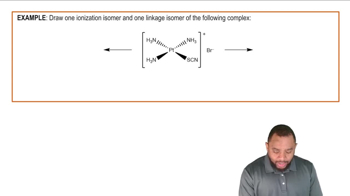
Isomerism

Isomerism refers to the phenomenon where two or more compounds have the same molecular formula but different structural arrangements of atoms. In the case of chloropropane, isomers arise from the different positions where the chlorine atom can replace a hydrogen atom on the propane backbone, leading to distinct structural formulas.
Video consigliato:
Percorso guidato
2:14
Isomerism in Coordination Complexes Example

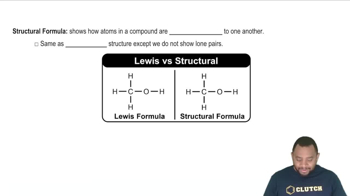
Structural Formula

A structural formula represents the arrangement of atoms within a molecule, showing how the atoms are bonded to each other. For chloropropane, drawing the structural formulas involves illustrating the carbon skeleton of propane and indicating the position of the chlorine atom, which is crucial for distinguishing between the isomers.
Video consigliato:
Percorso guidato
01:00
Structural Formula

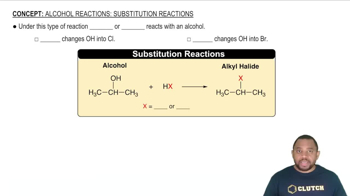
Substitution Reaction

A substitution reaction is a type of chemical reaction where one functional group in a molecule is replaced by another. In the context of chloropropane, the reaction involves substituting a hydrogen atom in propane with a chlorine atom, resulting in the formation of chloropropane isomers, which are important in organic chemistry.
Video consigliato:
Percorso guidato
01:08
Alcohol Reactions: Substitution Reactions