Ch.2 - Atoms, Molecules, and Ions
Brown - Chemistry: The Central Science 14th Edition
Brown14th EditionChemistry: The Central ScienceISBN: 9780134414232Non è quello che usi tu?Cambia libro di testo
Capitolo 2, Problema 23b

Consider an atom of 10B. (b) What is the symbol of the atom obtained by adding one proton to 10B?

Guida verificata passo dopo passo
1
Step 1: Understand the problem. The problem is asking for the symbol of the atom obtained by adding one proton to an atom of 10B. The atomic number of an atom is determined by the number of protons in its nucleus. For boron (B), the atomic number is 5, which means it has 5 protons.
Step 2: Add one proton to the atom. When you add one proton to an atom of boron, the atomic number increases by one. This means the atomic number of the new atom is 6.
Step 3: Identify the atom with the atomic number 6. Using the periodic table, you can find that the element with atomic number 6 is carbon (C).
Step 4: Write the symbol for the new atom. The symbol for an atom includes the atomic number (number of protons), the chemical symbol, and the mass number (number of protons + number of neutrons). In this case, the atomic number is 6, the chemical symbol is C, and the mass number is still 10 (since we haven't added or removed any neutrons).
Step 5: The symbol for the atom obtained by adding one proton to 10B is 10C.

Risposta video verificata per un problema simile:

Questa soluzione video è stata consigliata dai nostri tutor come utile per risolvere questo problema.
Durata del video:
2m

Concetti chiave

Ecco i concetti essenziali che devi comprendere per rispondere correttamente alla domanda.

Atomic Structure

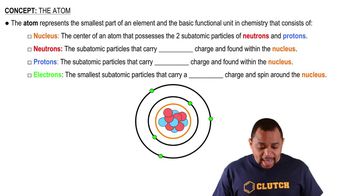
Atoms consist of protons, neutrons, and electrons. The number of protons in the nucleus defines the atomic number, which determines the element's identity. For example, boron (B) has an atomic number of 5, meaning it has 5 protons.
Video consigliato:

Isotopes

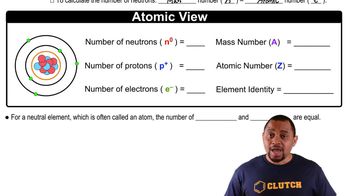
Isotopes are variants of a chemical element that have the same number of protons but different numbers of neutrons. The notation, such as 10B, indicates the total number of protons and neutrons in the nucleus. In this case, 10B has 5 protons and 5 neutrons.
Video consigliato:

Nuclear Reactions

Adding a proton to an atom results in a nuclear reaction that changes the element into a different one. For instance, adding one proton to 10B (which has 5 protons) transforms it into 11C (carbon), which has 6 protons. This process illustrates how elements can change identity through nuclear interactions.
Video consigliato:
Percorso guidato
02:06
Nuclear Binding Energy