Determine whether each of the following statements is true or false. If false, correct the statement to make it true: (a) The nucleus has most of the mass and comprises most of the volume of an atom.
Ch.2 - Atoms, Molecules, and Ions
Brown14th EditionChemistry: The Central ScienceISBN: 9780134414232Non è quello che usi tu?Cambia libro di testo
Capitolo 2, Problema 22c
Determine whether each of the following statements is true or false. If false, correct the statement to make it true: (c) The number of electrons in an atom equals the number of neutrons in the atom.
Guida verificata passo dopo passo1
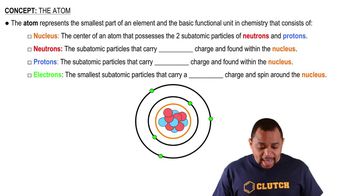
Understand the structure of an atom: An atom consists of protons, neutrons, and electrons.
Recall that the number of protons in an atom is equal to the atomic number, and in a neutral atom, the number of electrons equals the number of protons.
Recognize that the number of neutrons can vary even among atoms of the same element, leading to different isotopes.
Identify that the statement 'The number of electrons in an atom equals the number of neutrons in the atom' is generally false.
Correct the statement: In a neutral atom, the number of electrons equals the number of protons, not necessarily the number of neutrons.

Risposta video verificata per un problema simile:
Questa soluzione video è stata consigliata dai nostri tutor come utile per risolvere questo problema.
Durata del video:
1mConcetti chiave
Ecco i concetti essenziali che devi comprendere per rispondere correttamente alla domanda.
Atomic Structure
Atoms are composed of three primary subatomic particles: protons, neutrons, and electrons. Protons and neutrons reside in the nucleus, while electrons orbit around the nucleus. The number of protons defines the element, while the number of electrons typically equals the number of protons in a neutral atom, ensuring electrical neutrality.
Video consigliato:
Percorso guidato
Atom Structure
Electrons vs. Neutrons
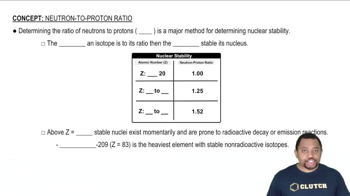
Electrons and neutrons serve different roles in an atom. Electrons are negatively charged and are involved in chemical bonding and reactions, while neutrons are neutral particles that contribute to the atomic mass and stability of the nucleus. The number of neutrons can vary in isotopes of an element, unlike electrons, which are usually equal to protons in neutral atoms.
Video consigliato:
Percorso guidato
Neutron-Proton Ratio
True/False Statements in Science
In scientific reasoning, statements can often be evaluated as true or false based on established facts. When a statement is false, it is important to identify the error and provide a corrected version. In this case, the statement incorrectly equates the number of electrons with neutrons, which can be corrected by stating that the number of electrons equals the number of protons in a neutral atom.
Video consigliato:
Percorso guidato
Third Law of Thermodynamics Example
Pratica correlata
Domanda del libro di testo
835
views
Domanda del libro di testo
Determine whether each of the following statements is true or false. If false, correct the statement to make it true: (b) Every atom of a given element has the same number of protons.
585
views
Domanda del libro di testo
Consider an atom of 10B. (a) How many protons, neutrons, and electrons does this atom contain?
1107
views
Domanda del libro di testo
Consider an atom of 10B. (b) What is the symbol of the atom obtained by adding one proton to 10B?
485
views
Domanda del libro di testo
Determine whether each of the following statements is true or false. If false, correct the statement to make it true: (d) The protons in the nucleus of the helium atom are held together by a force called the strong nuclear force.
764
views