Ch.2 - Atoms, Molecules, and Ions
Brown - Chemistry: The Central Science 14th Edition
Brown14th EditionChemistry: The Central ScienceISBN: 9780134414232Non è quello che usi tu?Cambia libro di testo
Capitolo 2, Problema 107a

Fill in the blanks in the following table:
Cation Anion Formula Name
Lithium oxide
Fe2+ PO43-
Al2(SO4)3
Copper(II) nitrate
Cr3+ I−
MnClO2
Ammonium carbonate
Zinc perchlorate
Complete the first column of the table.

Guida verificata passo dopo passo
1
Identify the cation and anion for each compound.
For 'Lithium oxide', the cation is Li+ and the anion is O2-.
For 'Fe2+ PO43-', the cation is Fe2+ and the anion is PO43-.
For 'Al2(SO4)3', the cation is Al3+ and the anion is SO42-.
For 'Copper(II) nitrate', the cation is Cu2+ and the anion is NO3-.

Risposta video verificata per un problema simile:

Questa soluzione video è stata consigliata dai nostri tutor come utile per risolvere questo problema.
Durata del video:
2m

Concetti chiave

Ecco i concetti essenziali che devi comprendere per rispondere correttamente alla domanda.

Ionic Compounds

Ionic compounds are formed from the electrostatic attraction between cations (positively charged ions) and anions (negatively charged ions). They typically consist of a metal and a non-metal, where the metal donates electrons to become a cation, while the non-metal accepts electrons to become an anion. Understanding the formation and naming conventions of these compounds is essential for completing the table.
Video consigliato:
Percorso guidato
02:11
Ionic Compounds Naming

Nomenclature of Ions

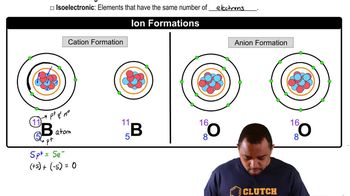
The nomenclature of ions involves specific rules for naming cations and anions. Cations are usually named after their parent element, often with the addition of a Roman numeral to indicate their charge, while anions typically have names derived from their parent element with suffixes like '-ide', '-ate', or '-ite' depending on their composition. Familiarity with these naming conventions is crucial for accurately filling in the table.
Video consigliato:

Chemical Formulas

Chemical formulas represent the composition of ionic compounds, indicating the types and ratios of ions present. The formula is derived from the charges of the cations and anions, ensuring that the overall charge of the compound is neutral. Understanding how to derive and interpret these formulas is key to completing the first column of the table correctly.
Video consigliato:
Percorso guidato
02:26
Skeletal Formula