Write the molecular and structural formulas for the compounds represented by the following molecular models:
Ch.2 - Atoms, Molecules, and Ions
Brown14th EditionChemistry: The Central ScienceISBN: 9780134414232Non è quello che usi tu?Cambia libro di testo
Capitolo 2, Problema 55
Fill in the gaps in the following table: Symbol 59Co3+ Protons 34 76 80 Neutrons 46 116 120 Electrons 36 78 Net charge 2+
Guida verificata passo dopo passo1
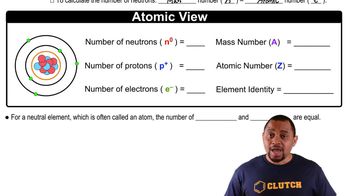
Identify the number of protons for each element using the atomic number, which is equal to the number of protons.
Calculate the number of electrons for each ion by considering the net charge: Electrons = Protons - Charge.
Determine the number of neutrons by subtracting the number of protons from the mass number: Neutrons = Mass Number - Protons.
For the given symbol 59Co3+, identify the number of protons from the periodic table (Co has 27 protons) and calculate the number of electrons considering the charge (27 - 3 = 24 electrons).
Fill in the missing values in the table using the calculated numbers of protons, neutrons, and electrons for each element or ion.

Risposta video verificata per un problema simile:
Questa soluzione video è stata consigliata dai nostri tutor come utile per risolvere questo problema.
Durata del video:
6mConcetti chiave
Ecco i concetti essenziali che devi comprendere per rispondere correttamente alla domanda.
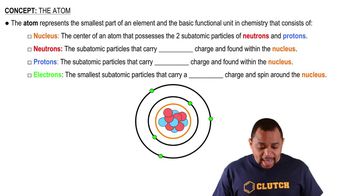
Atomic Structure
Atomic structure refers to the composition of an atom, which includes protons, neutrons, and electrons. Protons are positively charged particles found in the nucleus, while neutrons are neutral particles also located in the nucleus. Electrons are negatively charged and orbit the nucleus. The number of protons determines the element, while the balance of protons and electrons defines the atom's charge.
Video consigliato:
Percorso guidato
Atom Structure
Ions and Charge
Ions are atoms or molecules that have gained or lost one or more electrons, resulting in a net electric charge. A cation, like Co3+, has lost electrons, leading to a positive charge. The net charge of an ion is calculated by subtracting the number of electrons from the number of protons. Understanding how to determine the charge is essential for filling in the gaps in the provided table.
Video consigliato:
Percorso guidato
Polyatomic Ion Charges
Isotopes
Isotopes are variants of a particular chemical element that have the same number of protons but different numbers of neutrons. This difference in neutrons results in varying atomic masses. For example, cobalt (Co) can have isotopes with different neutron counts, affecting its stability and nuclear properties. Recognizing isotopes is crucial for accurately completing the table regarding neutrons and atomic mass.
Video consigliato:
Percorso guidato
Isotopes
Pratica correlata
Domanda del libro di testo
909
views
Domanda del libro di testo
Write the molecular and structural formulas for the compounds represented by the following models:
745
views
Domanda del libro di testo
Using the periodic table, predict the charge of the most stable ion of the following elements: (a) Li (b) Ba (c) Po (d) I
518
views
Domanda del libro di testo
Each of the following elements is capable of forming an ion in chemical reactions. By referring to the periodic table, predict the charge of the most stable ion of each: (a) Be (b) Rb (c) As (d) In (e) At.
682
views
Domanda del libro di testo
Fill in the gaps in the following table: Symbol 133Cs+ Protons 35 15 Neutrons 46 16 30 Electrons 18 20 Net charge 1- 5+
720
views
Domanda del libro di testo
How many of the indicated atoms are represented by each chemical formula: (b) oxygen atoms in Ca(ClO3)2 (c) hydrogen atoms in (NH4)2HPO4?
535
views