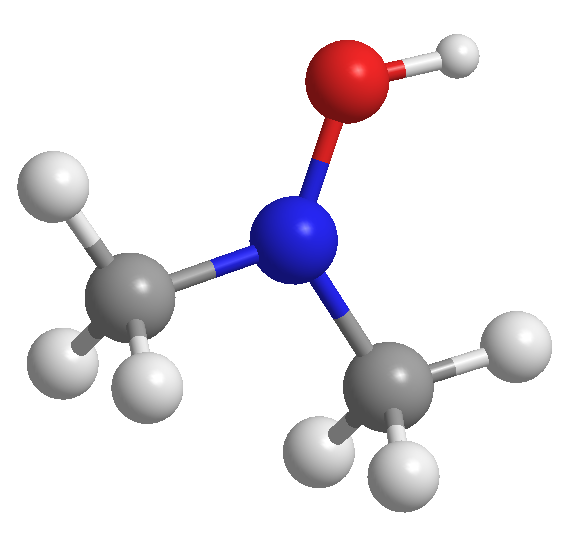
Write the molecular and structural formulas for the compounds represented by the following molecular models:
Ch.2 - Atoms, Molecules, and Ions
Brown14th EditionChemistry: The Central ScienceISBN: 9780134414232Non è quello che usi tu?Cambia libro di testo
Capitolo 2, Problema 54
Write the molecular and structural formulas for the compounds represented by the following models:

Guida verificata passo dopo passo1
Identify the atoms in the model: The model contains carbon (gray), hydrogen (white), nitrogen (blue), and oxygen (red) atoms.
Count the number of each type of atom: There are 2 carbon atoms, 5 hydrogen atoms, 1 nitrogen atom, and 1 oxygen atom.
Determine the molecular formula: Combine the counts of each type of atom to form the molecular formula.
Analyze the structure: Identify the connectivity of the atoms. The nitrogen atom is bonded to two carbon atoms, one of which is bonded to an oxygen atom and a hydrogen atom.
Write the structural formula: Based on the connectivity, draw the structural formula showing the arrangement of atoms and bonds.

Risposta video verificata per un problema simile:
Questa soluzione video è stata consigliata dai nostri tutor come utile per risolvere questo problema.
Durata del video:
2mConcetti chiave
Ecco i concetti essenziali che devi comprendere per rispondere correttamente alla domanda.
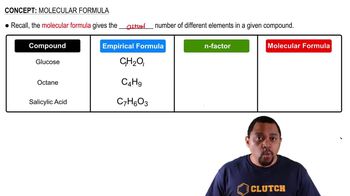
Molecular Formula
The molecular formula of a compound indicates the number and types of atoms present in a molecule. It is expressed using chemical symbols and subscripts, where each symbol represents an element and the subscript denotes the number of atoms of that element. For example, the molecular formula C2H6O indicates a molecule containing two carbon atoms, six hydrogen atoms, and one oxygen atom.
Video consigliato:
Percorso guidato
Determining Molecular Formulas
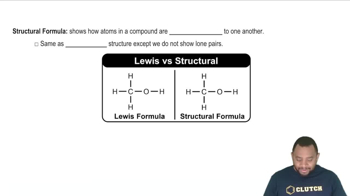
Structural Formula
The structural formula provides a visual representation of the arrangement of atoms within a molecule, showing how atoms are bonded to each other. It can depict single, double, or triple bonds and may include information about the geometry of the molecule. This is crucial for understanding the compound's reactivity and properties, as the arrangement of atoms affects how the molecule interacts with others.
Video consigliato:
Percorso guidato
Structural Formula
Chemical Bonding
Chemical bonding refers to the forces that hold atoms together in a molecule. The main types of bonds include covalent bonds, where atoms share electrons, and ionic bonds, where electrons are transferred between atoms. Understanding the type of bonding in a compound is essential for predicting its behavior, stability, and reactivity, as well as for deriving its molecular and structural formulas.
Video consigliato:
Percorso guidato
Chemical Bonds
Pratica correlata
Domanda del libro di testo
909
views
Domanda del libro di testo
Each of the following elements is capable of forming an ion in chemical reactions. By referring to the periodic table, predict the charge of the most stable ion of each: (a) Be (b) Rb (c) As (d) In (e) At.
682
views
Domanda del libro di testo
How many of the indicated atoms are represented by each chemical formula: (a) carbon atoms in C4H9COOCH3
551
views
Domanda del libro di testo
Fill in the gaps in the following table: Symbol 133Cs+ Protons 35 15 Neutrons 46 16 30 Electrons 18 20 Net charge 1- 5+
720
views
Domanda del libro di testo
Fill in the gaps in the following table: Symbol 59Co3+ Protons 34 76 80 Neutrons 46 116 120 Electrons 36 78 Net charge 2+
1573
views
1
comments
Domanda del libro di testo
How many of the indicated atoms are represented by each chemical formula: (b) oxygen atoms in Ca(ClO3)2 (c) hydrogen atoms in (NH4)2HPO4?
535
views