Ch.2 - Atoms, Molecules, and Ions
Brown - Chemistry: The Central Science 14th Edition
Brown14th EditionChemistry: The Central ScienceISBN: 9780134414232Non è quello che usi tu?Cambia libro di testo
Capitolo 2, Problema 72h,i

Name the following ionic compounds: (h) NaH2PO4 (i) KMnO4

Guida verificata passo dopo passo
1
Identify the cation and anion in the compound. Here, Na is the cation and H2PO4 is the anion.
Name the cation first. Na is sodium, so the cation is named 'sodium'.
Identify the anion. H2PO4 is the dihydrogen phosphate ion.
Combine the names of the cation and anion. The compound is named by stating the cation first followed by the anion.
The name of the compound is 'sodium dihydrogen phosphate'.

Risposta video verificata per un problema simile:

Questa soluzione video è stata consigliata dai nostri tutor come utile per risolvere questo problema.
Durata del video:
39s

Concetti chiave

Ecco i concetti essenziali che devi comprendere per rispondere correttamente alla domanda.

Ionic Compounds

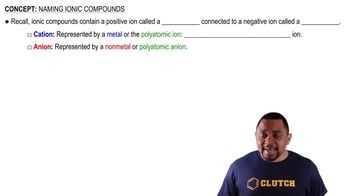
Ionic compounds are formed when atoms transfer electrons, resulting in the formation of positively charged cations and negatively charged anions. These oppositely charged ions attract each other, creating a stable compound. Understanding the nature of ionic bonds is essential for naming and writing formulas for these compounds.
Video consigliato:
Percorso guidato
02:11
Ionic Compounds Naming

Nomenclature of Ionic Compounds

The nomenclature of ionic compounds involves specific rules for naming the cations and anions. Cations are typically named after the element, while anions often have their names modified, usually by adding an '-ide' suffix for simple anions or using a specific name for polyatomic ions. Familiarity with these naming conventions is crucial for accurately identifying compounds.
Video consigliato:
Percorso guidato
02:11
Ionic Compounds Naming

Polyatomic Ions

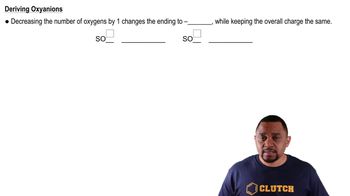
Polyatomic ions are ions composed of two or more atoms that are covalently bonded and carry a net charge. Common examples include sulfate (SO4^2-) and phosphate (PO4^3-). Recognizing polyatomic ions and their charges is vital for correctly naming compounds that contain them, such as NaH2PO4, which includes the dihydrogen phosphate ion (H2PO4^-).
Video consigliato:
Percorso guidato
01:20
Polyatomic Ion Variations