Ch.2 - Atoms, Molecules, and Ions
Brown - Chemistry: The Central Science 14th Edition
Brown14th EditionChemistry: The Central ScienceISBN: 9780134414232Non è quello che usi tu?Cambia libro di testo
Capitolo 2, Problema 73f

Write the chemical formulas for the following compounds: (f) iron(III)carbonate

Guida verificata passo dopo passo
1
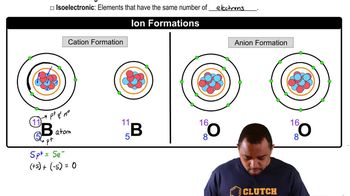
Identify the cation and its charge: Iron(III) indicates the iron cation with a charge of +3, written as \( \text{Fe}^{3+} \).
Identify the anion and its charge: Carbonate is a polyatomic ion with the formula \( \text{CO}_3^{2-} \).
Determine the ratio of cations to anions needed to balance the charges: To balance the charges between \( \text{Fe}^{3+} \) and \( \text{CO}_3^{2-} \), find the least common multiple of the charges, which is 6.
Calculate the number of each ion needed: You need 2 iron(III) ions (\( 2 \times +3 = +6 \)) and 3 carbonate ions (\( 3 \times -2 = -6 \)) to balance the charges.
Write the chemical formula by combining the ions in the correct ratio: The formula for iron(III) carbonate is \( \text{Fe}_2(\text{CO}_3)_3 \).

Risposta video verificata per un problema simile:

Questa soluzione video è stata consigliata dai nostri tutor come utile per risolvere questo problema.
Durata del video:
1m

Concetti chiave

Ecco i concetti essenziali che devi comprendere per rispondere correttamente alla domanda.

Iron(III) Ion

The iron(III) ion, denoted as Fe³⁺, is a cation formed when iron loses three electrons. This oxidation state is common in various iron compounds and is crucial for determining the overall charge balance in ionic compounds. Understanding the charge of the iron ion is essential for writing the correct formula for iron(III) carbonate.
Video consigliato:

Carbonate Ion

The carbonate ion, represented as CO₃²⁻, is a polyatomic ion consisting of one carbon atom covalently bonded to three oxygen atoms. It carries a -2 charge, which is important for balancing the charges when combined with cations like iron(III). Recognizing the structure and charge of the carbonate ion is vital for constructing the correct chemical formula.
Video consigliato:

Ionic Compound Formation

Ionic compounds are formed through the electrostatic attraction between cations and anions. The total positive charge from the cations must equal the total negative charge from the anions to achieve charge neutrality. In the case of iron(III) carbonate, one Fe³⁺ ion combines with three CO₃²⁻ ions to form the neutral compound, Fe₂(CO₃)₃.
Video consigliato:
Percorso guidato
02:11
Ionic Compounds Naming