Ch.2 - Atoms, Molecules, and Ions
Brown - Chemistry: The Central Science 14th Edition
Brown14th EditionChemistry: The Central ScienceISBN: 9780134414232Non è quello che usi tu?Cambia libro di testo
Capitolo 2, Problema 66g

Which of the following are ionic, and which are molecular? (g) CoCO3

Guida verificata passo dopo passo
1
Identify the types of elements in the compound: Co (Cobalt) is a metal, and C (Carbon) and O (Oxygen) are nonmetals.
Recognize that compounds containing metals and nonmetals are typically ionic, as metals tend to lose electrons and nonmetals tend to gain electrons.
Consider the nature of the bonding between the elements: CoCO3 (Cobalt Carbonate) consists of Co2+ and CO32- (carbonate ion).
Analyze the carbonate ion (CO32-): It is a polyatomic ion, which is a group of covalently bonded nonmetals with an overall charge, indicating ionic interaction with the metal cation.
Conclude that CoCO3 is an ionic compound due to the ionic bond between the metal cation (Co2+) and the polyatomic anion (CO32-).

Risposta video verificata per un problema simile:

Questa soluzione video è stata consigliata dai nostri tutor come utile per risolvere questo problema.
Durata del video:
1m

Concetti chiave

Ecco i concetti essenziali che devi comprendere per rispondere correttamente alla domanda.

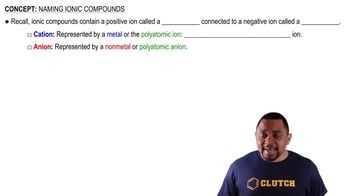
Ionic Compounds

Ionic compounds are formed when atoms transfer electrons, resulting in the formation of charged ions. These compounds typically consist of a metal and a non-metal, where the metal loses electrons to become a positively charged cation, and the non-metal gains electrons to become a negatively charged anion. Ionic compounds are characterized by high melting and boiling points and conduct electricity when dissolved in water.
Video consigliato:
Percorso guidato
02:11
Ionic Compounds Naming

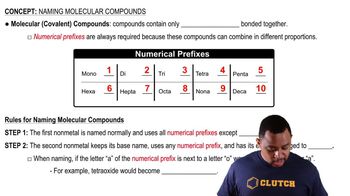
Molecular Compounds

Molecular compounds are formed when two or more non-metal atoms share electrons through covalent bonds. These compounds are characterized by lower melting and boiling points compared to ionic compounds and do not conduct electricity in solution. The properties of molecular compounds depend on the types of atoms involved and the arrangement of the molecules.
Video consigliato:
Percorso guidato
02:06
Naming Molecular Compounds

Chemical Formula Interpretation

The chemical formula of a compound provides essential information about its composition and structure. For example, CoCO₃ indicates the presence of cobalt (Co) and carbonate (CO₃) ions. Understanding the formula helps in determining whether the compound is ionic or molecular, as it reveals the types of elements involved and their bonding characteristics.
Video consigliato:
Percorso guidato
03:13
Intepreting the Band of Stability