Ch.2 - Atoms, Molecules, and Ions
Brown - Chemistry: The Central Science 14th Edition
Brown14th EditionChemistry: The Central ScienceISBN: 9780134414232Non è quello che usi tu?Cambia libro di testo
Capitolo 2, Problema 66b,c

Which of the following are ionic, and which are molecular? (b) NaI (c) Zr(NO3)2

Guida verificata passo dopo passo
1
Step 1: Understand the difference between ionic and molecular compounds. Ionic compounds are formed from the electrostatic attraction between cations and anions, typically involving a metal and a non-metal. Molecular compounds, also known as covalent compounds, are formed by the sharing of electrons between non-metals.
Step 2: Identify the elements in the compound NaI. Sodium (Na) is a metal, and iodine (I) is a non-metal.
Step 3: Determine the type of bond formed between the elements. Since Na is a metal and I is a non-metal, they are likely to form an ionic bond.
Step 4: Recall that in ionic compounds, the metal loses electrons to become a positively charged cation, while the non-metal gains electrons to become a negatively charged anion.
Step 5: Conclude that NaI is an ionic compound because it consists of a metal (Na) and a non-metal (I) forming an ionic bond.

Risposta video verificata per un problema simile:

Questa soluzione video è stata consigliata dai nostri tutor come utile per risolvere questo problema.
Durata del video:
7m

Concetti chiave

Ecco i concetti essenziali che devi comprendere per rispondere correttamente alla domanda.

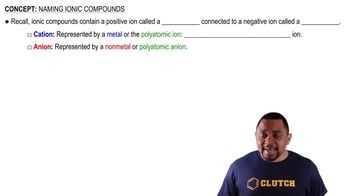
Ionic Compounds

Ionic compounds are formed when atoms transfer electrons, resulting in the formation of charged ions. These compounds typically consist of a metal and a non-metal, where the metal donates electrons to become a positively charged cation, and the non-metal accepts electrons to become a negatively charged anion. The electrostatic attraction between these oppositely charged ions holds the compound together.
Video consigliato:
Percorso guidato
02:11
Ionic Compounds Naming

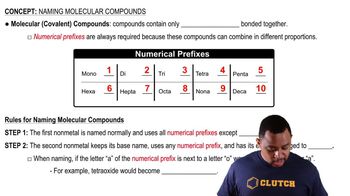
Molecular Compounds

Molecular compounds are formed when two or more non-metal atoms share electrons through covalent bonds. Unlike ionic compounds, molecular compounds do not consist of ions but rather discrete molecules. These compounds often have lower melting and boiling points compared to ionic compounds and can exist in various states (solid, liquid, gas) at room temperature.
Video consigliato:
Percorso guidato
02:06
Naming Molecular Compounds

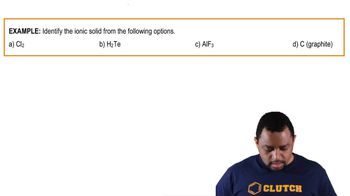
Identifying Ionic vs. Molecular

To determine whether a compound is ionic or molecular, one can examine its constituent elements. Compounds formed from metals and non-metals are typically ionic, while those formed from non-metals are molecular. Additionally, the presence of a polyatomic ion can indicate an ionic compound, while the absence of such ions and the presence of covalent bonds suggest a molecular compound.
Video consigliato:
Percorso guidato
00:34
Ionic Solid Identification Example