Ch.20 - Electrochemistry
Brown - Chemistry: The Central Science 14th Edition
Brown14th EditionChemistry: The Central ScienceISBN: 9780134414232Non è quello che usi tu?Cambia libro di testo
Capitolo 20, Problema 91b

(b) What amperage is required to plate out 0.250 mol Cr from a Cr3+ solution in a period of 8.00 h?

Guida verificata passo dopo passo
1
Identify the relevant electrochemical reaction: The reduction of Cr³⁺ to Cr metal is represented by the half-reaction: Cr³⁺ + 3e⁻ → Cr.
Determine the total charge needed: Since 1 mole of Cr requires 3 moles of electrons, calculate the total moles of electrons needed for 0.250 mol of Cr using the stoichiometry of the reaction.
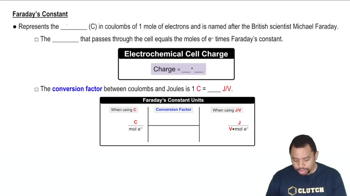
Convert moles of electrons to charge: Use Faraday's constant (approximately 96485 C/mol) to convert the moles of electrons to total charge in coulombs.
Calculate the current (amperage): Use the formula I = Q/t, where I is the current in amperes, Q is the total charge in coulombs, and t is the time in seconds. Convert the given time from hours to seconds.
Solve for the current: Substitute the values for Q and t into the formula to find the required current in amperes.

Risposta video verificata per un problema simile:

Questa soluzione video è stata consigliata dai nostri tutor come utile per risolvere questo problema.
Durata del video:
2m

Concetti chiave

Ecco i concetti essenziali che devi comprendere per rispondere correttamente alla domanda.

Faraday's Laws of Electrolysis

Faraday's Laws of Electrolysis state that the amount of substance deposited during electrolysis is directly proportional to the quantity of electric charge passed through the electrolyte. The first law quantifies this relationship, while the second law relates the mass of the substance to its molar mass and the number of electrons involved in the reaction.
Video consigliato:
Percorso guidato
01:40
Faraday's Constant in Electrochemistry

Amperage and Charge

Amperage, or current (I), is the flow of electric charge measured in amperes (A). The total charge (Q) can be calculated using the formula Q = I × t, where t is the time in seconds. Understanding this relationship is crucial for determining the current needed to achieve a specific electrochemical reaction over a given time.
Video consigliato:

Electrochemical Equivalent

The electrochemical equivalent (ECE) is the mass of a substance that can be deposited or dissolved by the passage of one coulomb of electric charge. For chromium ions (Cr³⁺), the ECE can be calculated using the molar mass and the number of electrons transferred in the reduction process, which is essential for determining the required amperage for plating.
Video consigliato:
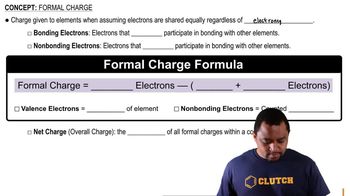
Percorso guidato
02:46
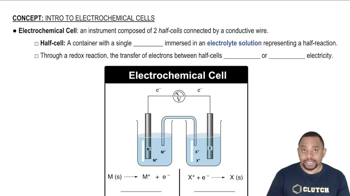
Electrochemical Cells