Ch.20 - Electrochemistry
Brown - Chemistry: The Central Science 14th Edition
Brown14th EditionChemistry: The Central ScienceISBN: 9780134414232Non è quello che usi tu?Cambia libro di testo
Capitolo 20, Problema 89d

(d) Why is sodium metal not obtained when an aqueous solution of NaCl undergoes electrolysis?

Guida verificata passo dopo passo
1
Understand the process of electrolysis: Electrolysis involves passing an electric current through a solution to cause a chemical change. In the case of NaCl, the solution is aqueous, meaning water is present.
Identify the ions present in the solution: In an aqueous NaCl solution, the ions present are Na⁺, Cl⁻, H⁺ (from water), and OH⁻ (from water).
Determine the possible reactions at the cathode: At the cathode, reduction occurs. The possible reductions are Na⁺ + e⁻ → Na (sodium metal) and 2H₂O + 2e⁻ → H₂ + 2OH⁻ (hydrogen gas).
Compare the reduction potentials: The reduction potential for Na⁺ to Na is more negative than that for water to hydrogen gas. This means that water is more easily reduced than Na⁺ in an aqueous solution.
Conclude why sodium metal is not obtained: Since water is reduced preferentially over Na⁺, hydrogen gas is produced at the cathode instead of sodium metal during the electrolysis of aqueous NaCl.

Risposta video verificata per un problema simile:

Questa soluzione video è stata consigliata dai nostri tutor come utile per risolvere questo problema.
Durata del video:
1m

Concetti chiave

Ecco i concetti essenziali che devi comprendere per rispondere correttamente alla domanda.

Electrolysis

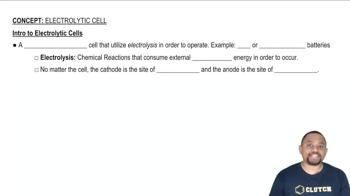
Electrolysis is a chemical process that uses electrical energy to drive a non-spontaneous reaction. In the context of aqueous solutions, it involves the decomposition of compounds into their constituent elements or ions when an electric current is passed through the solution. The process occurs at electrodes, where oxidation and reduction reactions take place, leading to the formation of different products depending on the ions present.
Video consigliato:
Percorso guidato
01:21
The Electrolytic Cell

Ionic Compounds in Aqueous Solution

When ionic compounds like NaCl dissolve in water, they dissociate into their respective ions, Na⁺ and Cl⁻. In an aqueous solution, water molecules also participate in the electrolysis process, which can lead to the production of hydrogen gas at the cathode and oxygen gas at the anode. The presence of water and its competing reactions significantly influences the products formed during electrolysis.
Video consigliato:
Percorso guidato
01:11
Types of Aqueous Solutions

Electrode Reactions and Product Formation

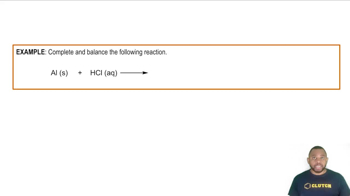
During electrolysis, the reactions that occur at the electrodes depend on the relative reactivity of the ions present. In the case of NaCl electrolysis, water is more easily reduced than sodium ions, leading to the production of hydrogen gas instead of sodium metal. Similarly, at the anode, chloride ions are oxidized to form chlorine gas, rather than oxidizing water to produce oxygen, which further explains why sodium metal is not obtained.
Video consigliato:
Percorso guidato
01:30
Production of Hydrogen Example