Ch.20 - Electrochemistry
Brown - Chemistry: The Central Science 14th Edition
Brown14th EditionChemistry: The Central ScienceISBN: 9780134414232Non è quello che usi tu?Cambia libro di testo
Capitolo 20, Problema 88c,d

Copper corrodes to cuprous oxide, Cu2O, or cupric oxide, CuO, depending on environmental conditions. (c) Copper peroxide is another oxidation product of elemental copper. Suggest a formula for copper peroxide based on its name. (d) Copper(III) oxide is another unusual oxidation product of elemental copper. Suggest a chemical formula for copper(III) oxide.

Guida verificata passo dopo passo
1
To determine the formula for copper peroxide, we need to understand the naming convention. 'Peroxide' indicates the presence of the peroxide ion, which is \( \text{O}_2^{2-} \). Copper typically forms \( \text{Cu}^{+} \) or \( \text{Cu}^{2+} \) ions, but in this case, we assume it forms \( \text{Cu}^{2+} \) to balance the charge with the peroxide ion.
The formula for copper peroxide can be deduced by balancing the charges between copper and the peroxide ion. Since the peroxide ion has a charge of \( 2- \) and copper is \( \text{Cu}^{2+} \), the formula is \( \text{CuO}_2 \).
For copper(III) oxide, we need to consider the oxidation state of copper. Copper(III) indicates that copper is in the +3 oxidation state, represented as \( \text{Cu}^{3+} \).
To balance the charges in copper(III) oxide, we need to pair \( \text{Cu}^{3+} \) with oxygen, which typically forms \( \text{O}^{2-} \) ions. To balance the charges, two copper ions (total charge of +6) would pair with three oxide ions (total charge of -6).
Thus, the chemical formula for copper(III) oxide is \( \text{Cu}_2\text{O}_3 \).

Risposta video verificata per un problema simile:

Questa soluzione video è stata consigliata dai nostri tutor come utile per risolvere questo problema.
Durata del video:
1m

Concetti chiave

Ecco i concetti essenziali che devi comprendere per rispondere correttamente alla domanda.

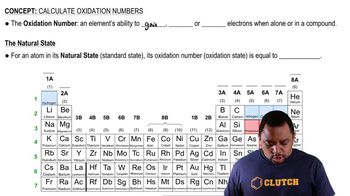
Oxidation States

Oxidation states indicate the degree of oxidation of an atom in a compound. For copper, common oxidation states include +1 (cuprous) and +2 (cupric), with +3 being less common. Understanding oxidation states is crucial for determining the correct chemical formulas for compounds like copper oxide and copper peroxide.
Video consigliato:
Percorso guidato
02:42
Oxidation Numbers

Chemical Nomenclature

Chemical nomenclature is the system of naming chemical compounds based on their composition and structure. For example, 'copper(III) oxide' indicates that copper has an oxidation state of +3 in the compound. Familiarity with nomenclature rules helps in deducing the correct formulas for compounds from their names.
Video consigliato:
Percorso guidato
03:31
Chemical Properties

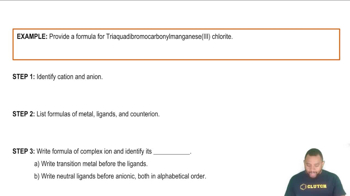
Compound Formulas

The formula of a compound reflects the types and numbers of atoms present. For copper peroxide, the name suggests a compound containing copper and oxygen, likely with copper in a +1 oxidation state, leading to the formula CuO2. Similarly, copper(III) oxide would be represented as Cu2O3, indicating the presence of copper in a +3 state.
Video consigliato:
Percorso guidato
03:37
Writing Formulas of Coordination Compounds Example