
Ch.20 - Electrochemistry
Brown - Chemistry: The Central Science 14th Edition
Brown14th EditionChemistry: The Central ScienceISBN: 9780134414232Non è quello che usi tu?Cambia libro di testo
Capitolo 20, Problema 116

Cytochrome, a complicated molecule that we will represent as CyFe2+, reacts with the air we breathe to supply energy required to synthesize adenosine triphosphate (ATP). The body uses ATP as an energy source to drive other reactions (Section 19.7). At pH 7.0 the following reduction potentials pertain to this oxidation of CyFe2+: O21g2 + 4 H+1aq2 + 4 e- ¡ 2 H2O1l2 Ered ° = +0.82 V CyFe3+1aq2 + e- ¡ CyFe2+1aq2 E°red = +0.22 V (a) What is ∆G for the oxidation of CyFe2+ by air? (b) If the synthesis of 1.00 mol of ATP from adenosine diphosphate (ADP) requires a ∆G of 37.7 kJ, how many moles of ATP are synthesized per mole of O2?

Guida verificata passo dopo passo
1
Step 1: Identify the half-reactions involved in the oxidation of CyFe^{2+} by O_2. The given half-reactions are: (1) O_2(g) + 4H^+(aq) + 4e^- \(\rightarrow\) 2H_2O(l) with E_{red}^\(\circ\) = +0.82 \(\text{ V}\) and (2) CyFe^{3+}(aq) + e^- \(\rightarrow\) CyFe^{2+}(aq) with E_{red}^\(\circ\) = +0.22 \(\text{ V}\).
Step 2: Determine the overall cell reaction by reversing the second half-reaction (since it is an oxidation) and adding it to the first half-reaction. The oxidation reaction is: CyFe^{2+}(aq) \(\rightarrow\) CyFe^{3+}(aq) + e^-.
Step 3: Calculate the standard cell potential (E_{cell}^\(\circ\)) by subtracting the reduction potential of the oxidation half-reaction from the reduction potential of the reduction half-reaction: E_{cell}^\(\circ\) = E_{red}^\(\circ\) (O_2) - E_{red}^\(\circ\) (CyFe^{3+/2+}).
Step 4: Use the Nernst equation to calculate \(\Delta\) G^\(\circ\) for the overall reaction: \(\Delta\) G^\(\circ\) = -nFE_{cell}^\(\circ\), where n is the number of moles of electrons transferred (4 in this case) and F is the Faraday constant (96485 C/mol).
Step 5: To find how many moles of ATP are synthesized per mole of O_2, divide the \(\Delta\) G^\(\circ\) of the reaction by the \(\Delta\) G required to synthesize 1 mole of ATP (37.7 kJ/mol). This will give the number of moles of ATP produced per mole of O_2.

Risposta video verificata per un problema simile:

Questa soluzione video è stata consigliata dai nostri tutor come utile per risolvere questo problema.
Durata del video:
4m

Concetti chiave

Ecco i concetti essenziali che devi comprendere per rispondere correttamente alla domanda.

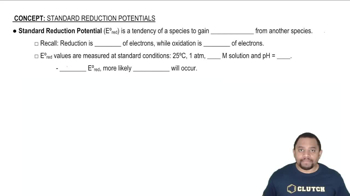
Reduction Potentials

Reduction potentials indicate the tendency of a chemical species to gain electrons and be reduced. A higher reduction potential means a greater likelihood of reduction occurring. In electrochemistry, these values are crucial for determining the direction of electron flow in redox reactions, which is essential for calculating Gibbs free energy changes.
Video consigliato:
Percorso guidato
01:10
Standard Reduction Potentials

Gibbs Free Energy (∆G)

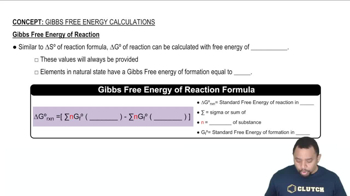
Gibbs free energy is a thermodynamic quantity that measures the maximum reversible work obtainable from a thermodynamic system at constant temperature and pressure. The change in Gibbs free energy (∆G) during a reaction indicates whether the process is spontaneous (∆G < 0) or non-spontaneous (∆G > 0). It is calculated using the equation ∆G = -nFE, where n is the number of moles of electrons transferred, F is Faraday's constant, and E is the cell potential.
Video consigliato:
Percorso guidato
01:51
Gibbs Free Energy of Reactions

ATP Synthesis

Adenosine triphosphate (ATP) is the primary energy carrier in cells, synthesized from adenosine diphosphate (ADP) and inorganic phosphate (Pi) through processes like oxidative phosphorylation. The synthesis of ATP is coupled to exergonic reactions, such as the oxidation of cytochromes, which release energy. Understanding the relationship between the energy released in redox reactions and the energy required for ATP synthesis is key to determining how many moles of ATP can be produced from a given reaction.
Video consigliato:
Percorso guidato
03:05
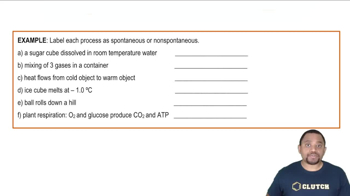
Spontaneity of Processes Example