
Ch.20 - Electrochemistry
Brown - Chemistry: The Central Science 14th Edition
Brown14th EditionChemistry: The Central ScienceISBN: 9780134414232Non è quello che usi tu?Cambia libro di testo
Capitolo 20, Problema 113e

Aqueous solutions of ammonia 1NH32 and bleach (active ingredient NaOCl) are sold as cleaning fluids, but bottles of both of them warn: 'Never mix ammonia and bleach, as toxic gases may be produced.' One of the toxic gases that can be produced is chloroamine, NH2Cl. (e) Is N oxidized, reduced, or neither, upon the conversion of ammonia to nitrogen trichloride?

Guida verificata passo dopo passo
1
Identify the oxidation state of nitrogen in ammonia (NH_3).
Determine the oxidation state of nitrogen in nitrogen trichloride (NCl_3).
Compare the oxidation states of nitrogen in NH_3 and NCl_3.
If the oxidation state of nitrogen increases, it is oxidized; if it decreases, it is reduced; if it remains the same, it is neither.
Conclude whether nitrogen is oxidized, reduced, or neither based on the change in oxidation state.

Risposta video verificata per un problema simile:

Questa soluzione video è stata consigliata dai nostri tutor come utile per risolvere questo problema.
Durata del video:
4m

Concetti chiave

Ecco i concetti essenziali che devi comprendere per rispondere correttamente alla domanda.

Oxidation and Reduction

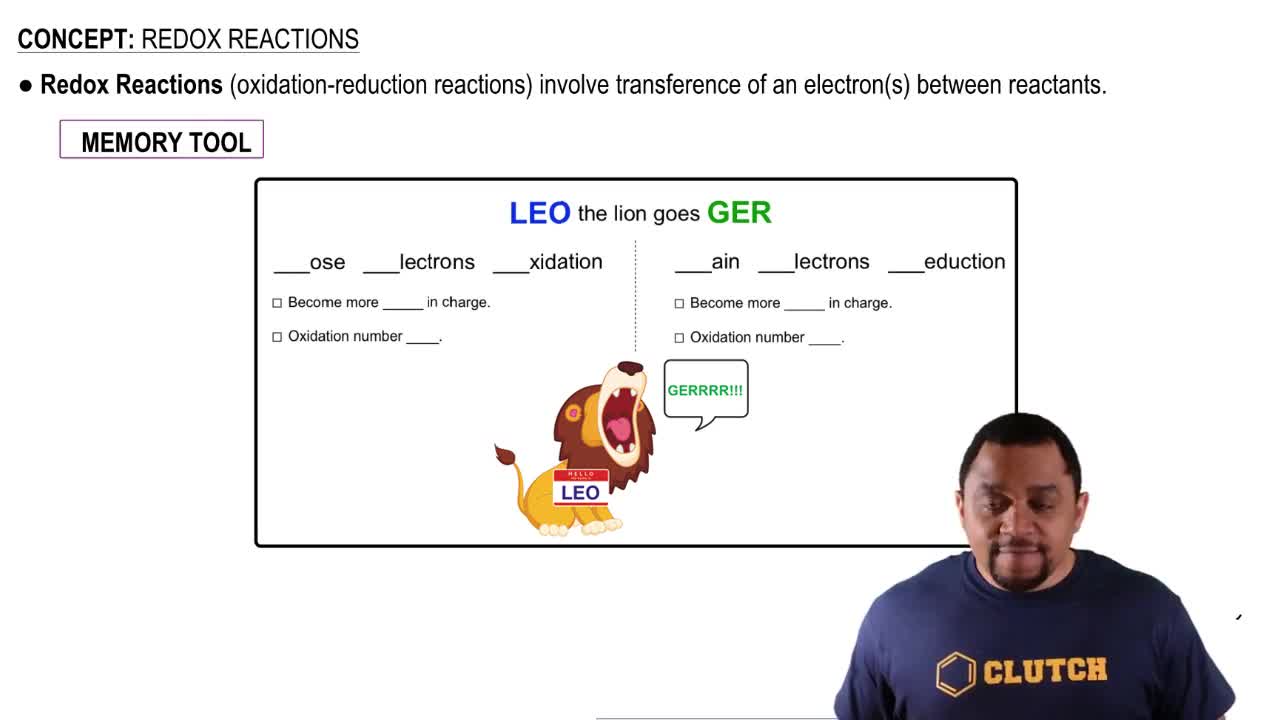
Oxidation and reduction are chemical processes that involve the transfer of electrons between substances. Oxidation refers to the loss of electrons, resulting in an increase in oxidation state, while reduction involves the gain of electrons, leading to a decrease in oxidation state. Understanding these concepts is crucial for determining the changes in oxidation states of elements during chemical reactions.
Video consigliato:
Percorso guidato
01:53
Oxidation and Reduction Reactions

Oxidation States

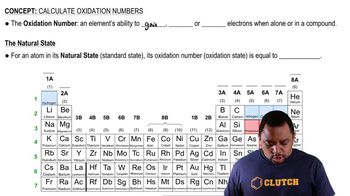
Oxidation states (or oxidation numbers) are assigned to atoms in a compound to indicate their degree of oxidation or reduction. The oxidation state of an element in a compound can help track electron transfer during reactions. For example, in the conversion of ammonia to nitrogen trichloride, analyzing the oxidation states of nitrogen can reveal whether it is oxidized or reduced.
Video consigliato:
Percorso guidato
02:42
Oxidation Numbers

Chloroamines Formation

Chloroamines are a class of compounds formed when ammonia reacts with chlorine-containing agents, such as bleach. The formation of chloroamines involves the substitution of hydrogen atoms in ammonia with chlorine atoms, which can lead to the release of toxic gases. Understanding the chemistry of chloroamines is essential for assessing the safety and risks associated with mixing ammonia and bleach.
Video consigliato:
Percorso guidato
02:34
Enthalpy of Formation
Pratica correlata
Domanda del libro di testo

Aqueous solutions of ammonia (NH3) and bleach (active ingredient NaOCl) are sold as cleaning fluids, but bottles of both of them warn: 'Never mix ammonia and bleach, as toxic gases may be produced.' One of the toxic gases that can be produced is chloroamine, NH2Cl. (a) What is the oxidation number of chlorine in bleach? (active ingredient NaOCl) are sold as cleaning fluids, but bottles of both of them warn: “Never mix ammonia and bleach, as toxic gases may be produced.” One of the toxic gases that can be produced is chloroamine, NH2Cl. (b) What is the oxidation number of chlorine in chloramine? (d) Another toxic gas that can be produced is nitrogen trichloride, NCl3. What is the oxidation number of N in nitrogen trichloride?

378
views
Domanda del libro di testo

Cytochrome, a complicated molecule that we will represent as CyFe2+, reacts with the air we breathe to supply energy required to synthesize adenosine triphosphate (ATP). The body uses ATP as an energy source to drive other reactions (Section 19.7). At pH 7.0 the following reduction potentials pertain to this oxidation of CyFe2+: O21g2 + 4 H+1aq2 + 4 e- ¡ 2 H2O1l2 Ered ° = +0.82 V CyFe3+1aq2 + e- ¡ CyFe2+1aq2 E°red = +0.22 V (a) What is ∆G for the oxidation of CyFe2+ by air? (b) If the synthesis of 1.00 mol of ATP from adenosine diphosphate (ADP) requires a ∆G of 37.7 kJ, how many moles of ATP are synthesized per mole of O2?

382
views
Domanda del libro di testo

The Haber process is the principal industrial route for converting nitrogen into ammonia: N2(g) + 3 H2(g) → 2 NH3(g) (b) Using the thermodynamic data in Appendix C, calculate the equilibrium constant for the process at room temperature.

717
views