
Ch.20 - Electrochemistry
Brown - Chemistry: The Central Science 14th Edition
Brown14th EditionChemistry: The Central ScienceISBN: 9780134414232Non è quello che usi tu?Cambia libro di testo
Capitolo 20, Problema 106c

Disulfides are compounds that have S ¬ S bonds, like peroxides have O ¬ O bonds. Thiols are organic compounds that have the general formula R ¬ SH, where R is a generic hydrocarbon. The SH- ion is the sulfur counterpart of hydroxide, OH-. Two thiols can react to make a disulfide, R ¬ S ¬ S ¬ R. (c) If you react two thiols to make a disulfide, are you oxidizing or reducing the thiols?

Guida verificata passo dopo passo
1
insert step 1> Identify the functional groups involved in the reaction: thiols (R-SH) and disulfides (R-S-S-R).
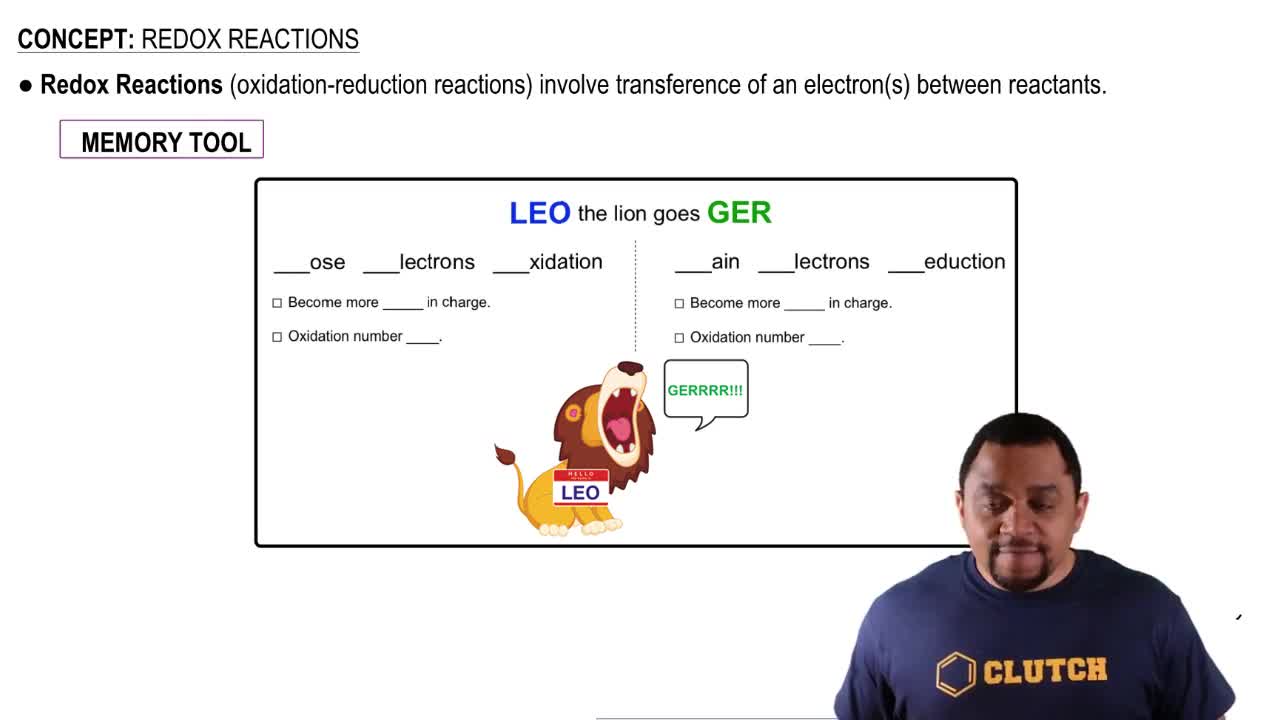
insert step 2> Understand the concept of oxidation and reduction: Oxidation involves the loss of electrons, while reduction involves the gain of electrons.
insert step 3> Analyze the change in oxidation state of sulfur: In thiols (R-SH), sulfur is in a lower oxidation state compared to disulfides (R-S-S-R).
insert step 4> Determine the electron transfer: When two thiols form a disulfide, each sulfur atom loses an electron, indicating oxidation.
insert step 5> Conclude that the reaction of two thiols to form a disulfide involves the oxidation of the thiols.

Risposta video verificata per un problema simile:

Questa soluzione video è stata consigliata dai nostri tutor come utile per risolvere questo problema.
Durata del video:
1m

Concetti chiave

Ecco i concetti essenziali che devi comprendere per rispondere correttamente alla domanda.

Oxidation and Reduction

Oxidation and reduction are chemical processes that involve the transfer of electrons between substances. Oxidation refers to the loss of electrons, while reduction involves the gain of electrons. In organic chemistry, oxidation often results in an increase in the number of bonds to oxygen or a decrease in bonds to hydrogen, while reduction typically has the opposite effect.
Video consigliato:
Percorso guidato
01:53
Oxidation and Reduction Reactions

Thiols and Disulfides

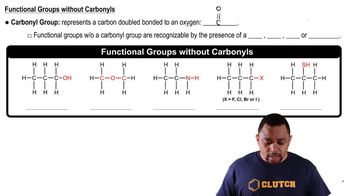
Thiols are organic compounds characterized by the presence of a sulfhydryl group (-SH), which can participate in redox reactions. When two thiols react, they can form a disulfide bond (R-S-S-R), which involves the coupling of two sulfur atoms. This transformation is significant in biochemistry, as disulfide bonds play a crucial role in stabilizing protein structures.
Video consigliato:
Percorso guidato
02:23
Non-Carbonyl Functional Groups

Redox Reaction in Thiol to Disulfide Conversion

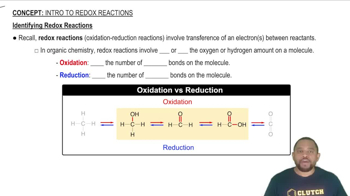
The conversion of two thiols into a disulfide bond is classified as an oxidation reaction. During this process, each thiol loses a hydrogen atom (as H+ and e-), resulting in the formation of the disulfide bond. Thus, the thiols are oxidized, while the disulfide formed is a more oxidized state of sulfur compared to the thiols.
Video consigliato:
Percorso guidato
03:12
Identifying Redox Reactions