
Ch.20 - Electrochemistry
Brown - Chemistry: The Central Science 14th Edition
Brown14th EditionChemistry: The Central ScienceISBN: 9780134414232Non è quello che usi tu?Cambia libro di testo
Capitolo 20, Problema 52a

For each of the following reactions, write a balanced equation, calculate the standard emf, calculate ∆G° at 298 K, and calculate the equilibrium constant K at 298 K. (a) Aqueous iodide ion is oxidized to I21s2 by Hg22+1aq2.

Guida verificata passo dopo passo
1
Step 1: Write the balanced redox reaction. Identify the oxidation and reduction half-reactions. For the given reaction, iodide ions (I-) are oxidized to iodine (I2), and mercury ions (Hg22+) are reduced. Balance each half-reaction for mass and charge.
Step 2: Combine the balanced half-reactions to form the overall balanced equation. Ensure that the number of electrons lost in the oxidation half-reaction equals the number of electrons gained in the reduction half-reaction.
Step 3: Calculate the standard cell potential (E°) using standard reduction potentials from a table. Use the formula: E° = E° (cathode) - E° (anode).
Step 4: Calculate the standard Gibbs free energy change (∆G°) using the formula: ∆G° = -nFE°, where n is the number of moles of electrons transferred, F is the Faraday constant (96,485 C/mol), and E° is the standard cell potential.
Step 5: Calculate the equilibrium constant (K) at 298 K using the relationship: ∆G° = -RT ln K, where R is the universal gas constant (8.314 J/mol·K) and T is the temperature in Kelvin. Rearrange to solve for K.

Risposta video verificata per un problema simile:

Questa soluzione video è stata consigliata dai nostri tutor come utile per risolvere questo problema.
Durata del video:
10m

Concetti chiave

Ecco i concetti essenziali che devi comprendere per rispondere correttamente alla domanda.

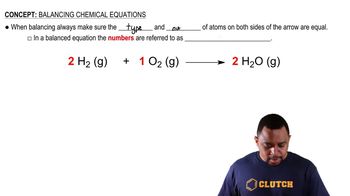
Balancing Chemical Equations

Balancing chemical equations involves ensuring that the number of atoms for each element is the same on both sides of the equation. This is crucial for accurately representing the conservation of mass during a chemical reaction. In redox reactions, it is also important to balance the charges, which may involve adding electrons to one side of the equation.
Video consigliato:
Percorso guidato
01:32
Balancing Chemical Equations

Standard Electromotive Force (emf)

The standard electromotive force (emf) of a reaction is the measure of the voltage produced by an electrochemical cell under standard conditions. It is calculated using standard reduction potentials from a table of half-reactions. A positive emf indicates a spontaneous reaction, while a negative emf suggests non-spontaneity.
Video consigliato:
Percorso guidato
01:10
Standard Reduction Potentials

Gibbs Free Energy (∆G°) and Equilibrium Constant (K)

Gibbs Free Energy (∆G°) is a thermodynamic quantity that indicates the spontaneity of a reaction at standard conditions. It is related to the equilibrium constant (K) by the equation ∆G° = -RT ln(K), where R is the gas constant and T is the temperature in Kelvin. A negative ∆G° corresponds to a reaction that favors products, while K > 1 indicates a product-favored equilibrium.
Video consigliato:
Pratica correlata
Domanda del libro di testo

For each of the following reactions, write a balanced equation, calculate the standard emf, calculate ∆G° at 298 K, and calculate the equilibrium constant K at 298 K. (b) In acidic solution, copper(I) ion is oxidized to copper(II) ion by nitrate ion.

380
views
Domanda del libro di testo

For each of the following reactions, write a balanced equation, calculate the standard emf, calculate ∆G° at 298 K, and calculate the equilibrium constant K at 298 K. (c) In basic solution, Cr1OH231s2 is oxidized to CrO42-1aq2 by ClO-1aq2.

312
views
Domanda del libro di testo

Given the following reduction half-reactions:

Fe3+(aq) + e- → Fe2+(aq) E°red = +0.77 V

S2O62-(aq) + 4 H+(aq) + 2 e- → 2 H2SO3(aq) E°red = +0.60 V

N2O(g) + 2 H+(aq) + 2 e- → N2(g) + H2O(l) E°red = -1.77 V

VO2+(aq) + 2 H+(aq) + e- → VO2+ + H2O(l) E°red = +1.00 V

(b) Calculate ∆G° for each reaction at 298 K.

369
views
Domanda del libro di testo

Given the following reduction half-reactions:

Fe3+(aq) + e- → Fe2+(aq) E°red = +0.77 V

S2O62-(aq) + 4 H+(aq) + 2 e- → 2 H2SO3(aq) E°red = +0.60 V

N2O(g) + 2 H+(aq) + 2 e- → N2(g) + H2O(l) E°red = -1.77 V

VO2+(aq) + 2 H+(aq) + e- → VO2+ + H2O(l) E°red = +1.00 V

(a) Write balanced chemical equations for the oxidation of Fe2+(aq) by S2O62-(aq), by N2O(aq), and by VO2+(aq).

728
views
Domanda del libro di testo

Given the following reduction half-reactions:

Fe3+(aq) + e- → Fe2+(aq) E°red = +0.77 V

S2O62-(aq) + 4 H+(aq) + 2 e- → 2 H2SO3(aq) E°red = +0.60 V

N2O(g) + 2 H+(aq) + 2 e- → N2(g) + H2O(l) E°red = -1.77 V

VO2+(aq) + 2 H+(aq) + e- → VO2+ + H2O(l) E°red = +1.00 V

(c) Calculate the equilibrium constant K for each reaction at 298 K.

1
views